
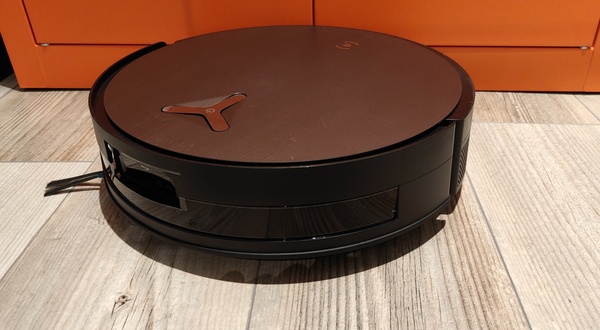
It's already been seven years since we reviewed the first robot vacuum that featured a separate dust container built into its charging dock. Since then, self-emptying robot vacuums have become the industry standard: practically every robot vacuum priced above €500 can now empty its own small internal dustbin into a larger dust bag located inside the charging dock.
Back then, the solution felt ingenious - and it still does. The usability of robot vacuums drops dramatically if users constantly have to manually empty the robot's tiny onboard dustbin.
But even then, we complained about one particularly silly design choice... Why on earth does the larger dock-mounted dust container rely on disposable dust bags, when traditional canister vacuum cleaners largely abandoned them sometime in the early 2010s? Buying dust bags is already irritating enough with conventional vacuums, but with robot vacuums it can eventually become nearly impossible as models age and compatible dust bags may only be available from questionable Chinese online stores.
Now, that rather ridiculous problem finally has a solution. We got our hands on Ecovacs' new flagship robot vacuum, the Ecovacs Deebot X11 Omnicyclone, launched around the turn of 2025/2026, where the dock's dust bag has been replaced by a fixed large-capacity dustbin.
At the time of review, the Ecovacs X11 Omnicyclone carries a fairly hefty $1,000/€1,200 price tag, but it also includes essentially everything you'd expect from a modern high-end robot vacuum: camera-based obstacle avoidance, mopping functionality, self-emptying, and automatic mop washing.
But compared to most competitors, the robot also introduces two notable new features: the previously mentioned bagless dock dustbin and the latest trend in robot vacuums, the so-called aqua roller-style mopping system.
We tested the Ecovacs for three months in a typical Nordic apartment to see how the robot would handle the challenges of a Northern Europe's winter and early spring, complete with gravel and sand dragged indoors from icy sidewalks.
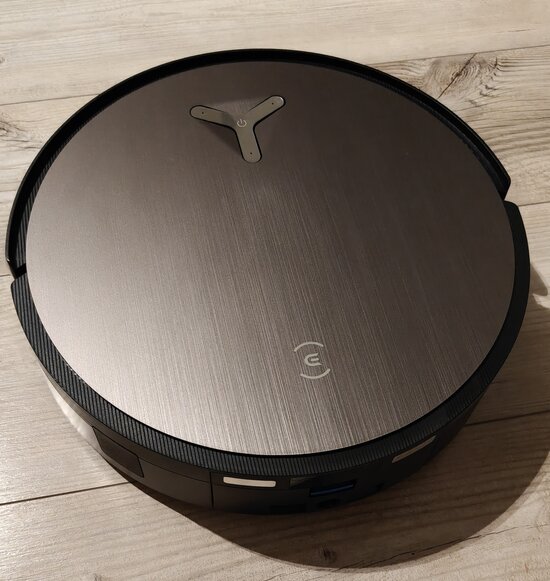
Visually, the Ecovacs X11 Omnicyclone looks very much like any modern robot vacuum: a relatively low-profile circular disc with a couple of physical buttons on top.
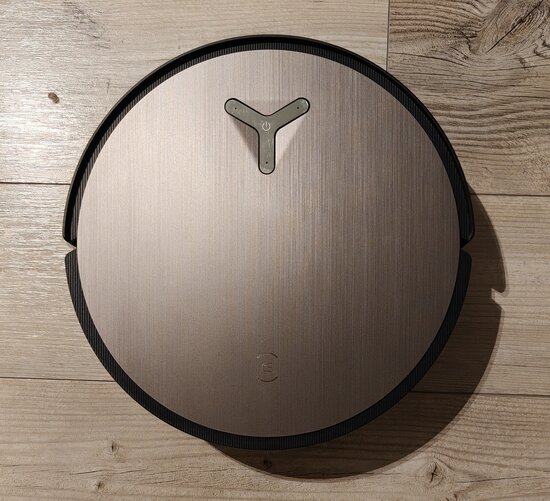
The robot itself features a dark gray matte finish and Ecovacs' familiar three-pronged logo, which also houses the robot's physical buttons.
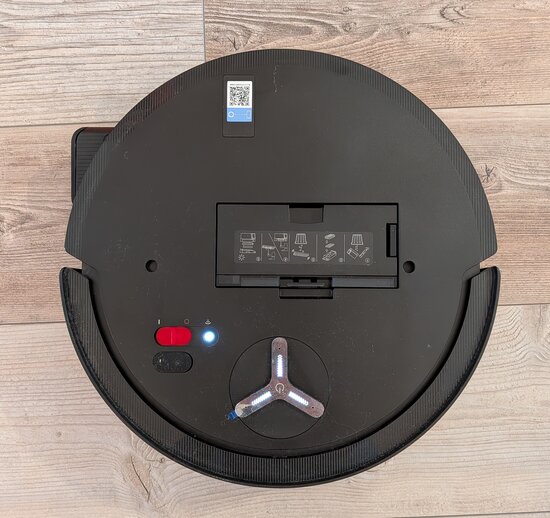
However, the matte gray surface on top is actually a removable cover panel that reveals more of the robot's internal hardware underneath. In practice, there's rarely any need to remove the panel, but it does provide access to the robot's internal dustbin and physical power button.
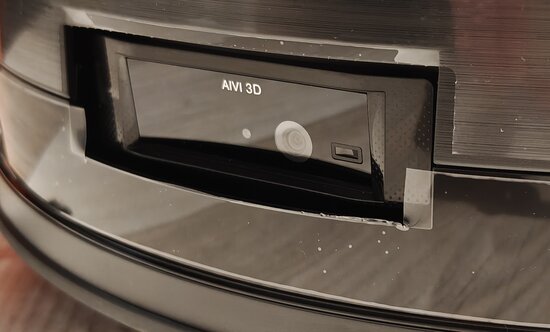
Like other premium obstacle-avoiding robot vacuums, the robot's front houses its cameras along with an auxiliary light that activates when needed. The camera system is used to identify and avoid obstacles on the floor.
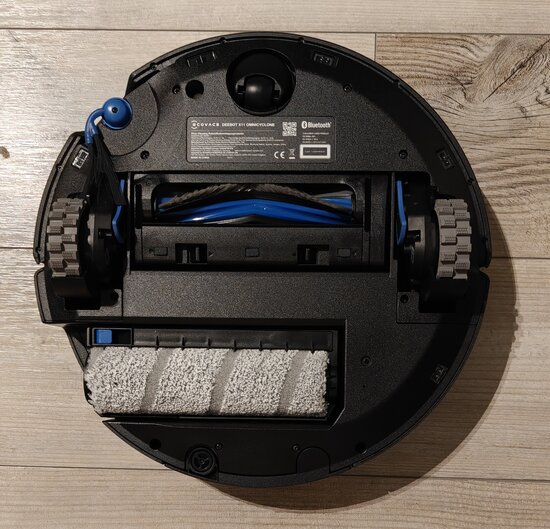
Things become more interesting once we flip the robot over. First, it's worth noting that Ecovacs stubbornly sticks to a single main brush design, even though our experience suggests that dual-brush systems generally provide better vacuuming results.
The second surprising detail concerns Ecovacs' side brush. Whereas most robot vacuums use a side brush consisting of three short bristles pointing in different directions, Ecovacs opted for a single flexible rubber-like arm that splits into two at the tip.
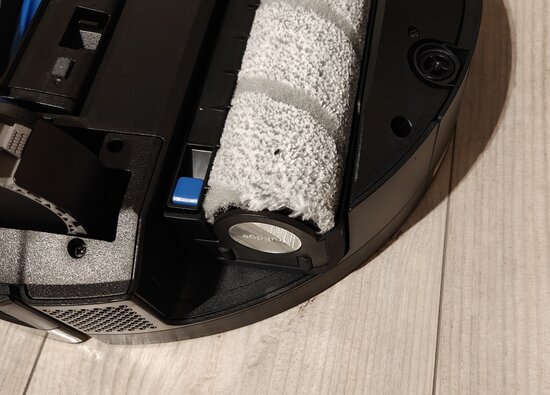
And the third noteworthy feature underneath is naturally one of the Ecovacs X11 Omnicyclone's signature selling points: the roller mop (also known as an aqua roller), which has recently become increasingly common among the most expensive mopping robot vacuums.
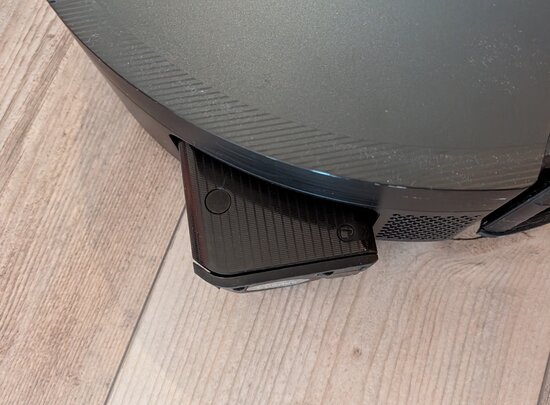
The cylindrical mop roller rotates similarly to the robot's main cleaning brush. Additionally, on the Ecovacs, the mop roller can extend several centimeters beyond the robot's side, allowing it to reach corners and edges more effectively.
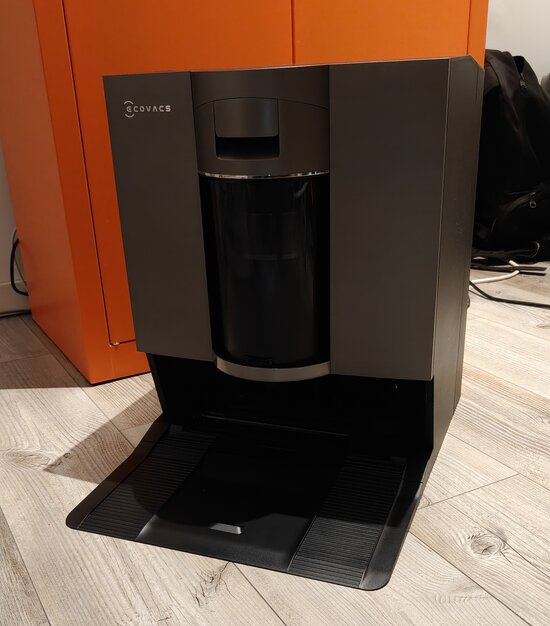
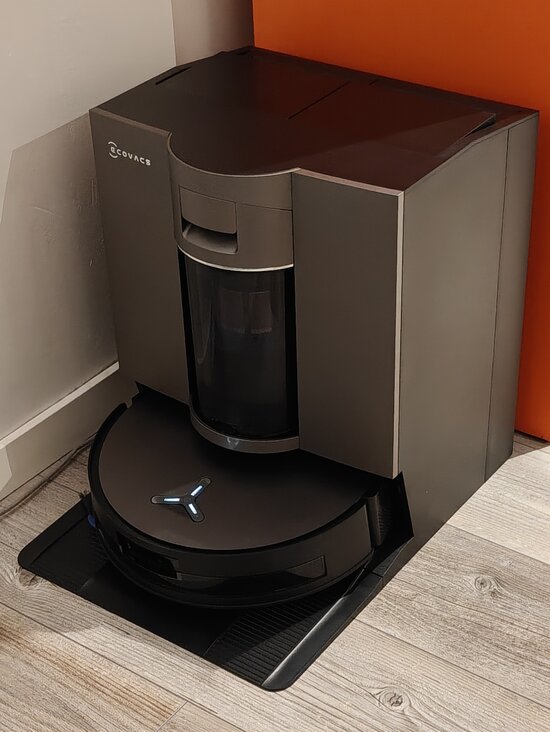
Then there's the docking station itself, which is - as expected in this price range - absolutely massive (without the base plate, the dock measures 38 x 33.5 x 46.5 cm).
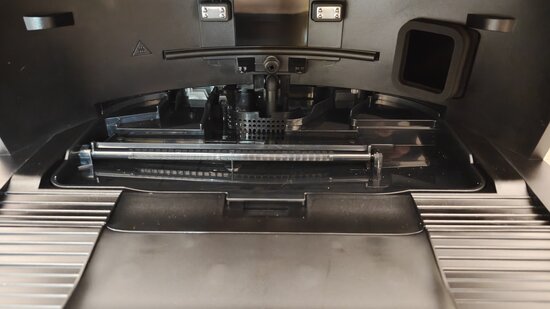
At the bottom of the dock sits the robot's parking bay, where it returns after every cleaning cycle. This compartment contains the mechanism used to wash the robot's mop roller, remove dirty water afterward, and dry the roller using warm air.
The same area also houses the mechanism used to empty the robot's internal dustbin into the dock's larger dust container.
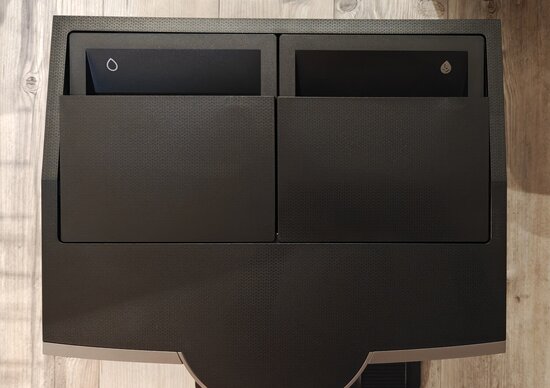
On top of the dock are the clean and dirty water tanks. The clean water tank holds 3.2 liters, while the dirty water tank has a capacity of 2.7 liters. Water is heated to 75°C during mop cleaning.
And then, of course, we arrive at the Ecovacs X11 Omnicyclone's biggest selling point: the removable bagless dustbin. At the front of the dock sits a plastic 1.6-liter container that can simply be unclipped and emptied into regular household trash once full.
The fixed dustbin built into the dock solves one of the biggest problems self-emptying robot vacuums have had: it eliminates the need to buy disposable dust bags.
Especially in homes with pets, dust bags can become a significant ongoing expense over time - not to mention the fact that replacement dust bags for robot vacuums are nowhere near as widely available as those for traditional vacuum cleaners.
Ecovacs' own smartphone app is available for both iPhone and Android (we tested it ourselves on Android), and it is exactly the same on both platforms. The app has been translated into even smaller languages - but unfortunately mostly with the help of AI and not particularly well.
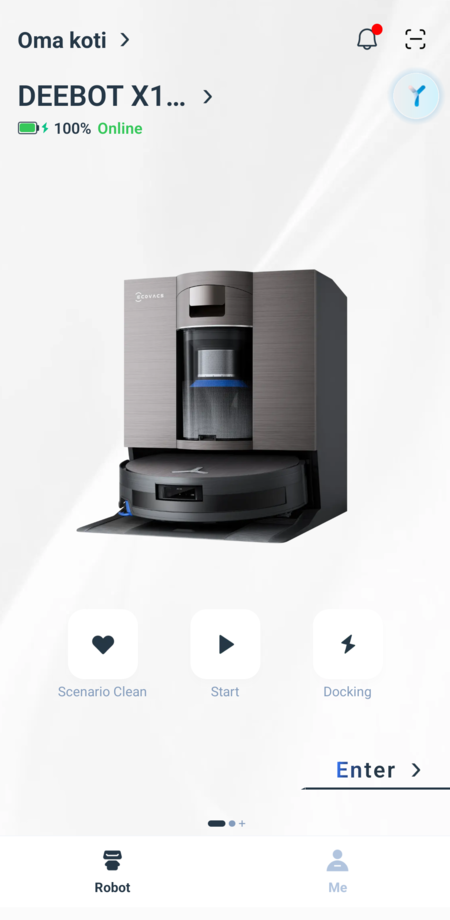
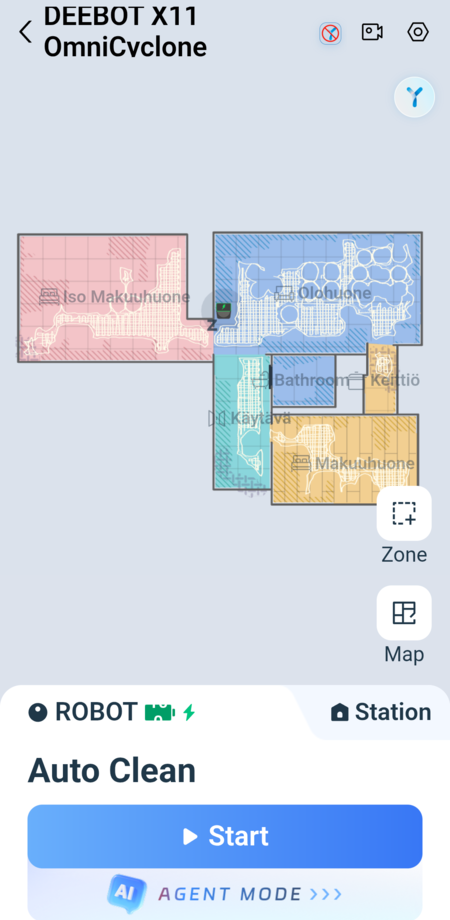
In general, Ecovacs' app follows very much the same logic as the apps used by virtually every other Chinese robot vacuum manufacturer: there is a dizzying amount of functionality and customization available, and various settings are hidden all over the place behind layers of menus. In other words, it will feel very familiar and comforting to anyone who once loved the user interface design philosophy of Nokia phones.
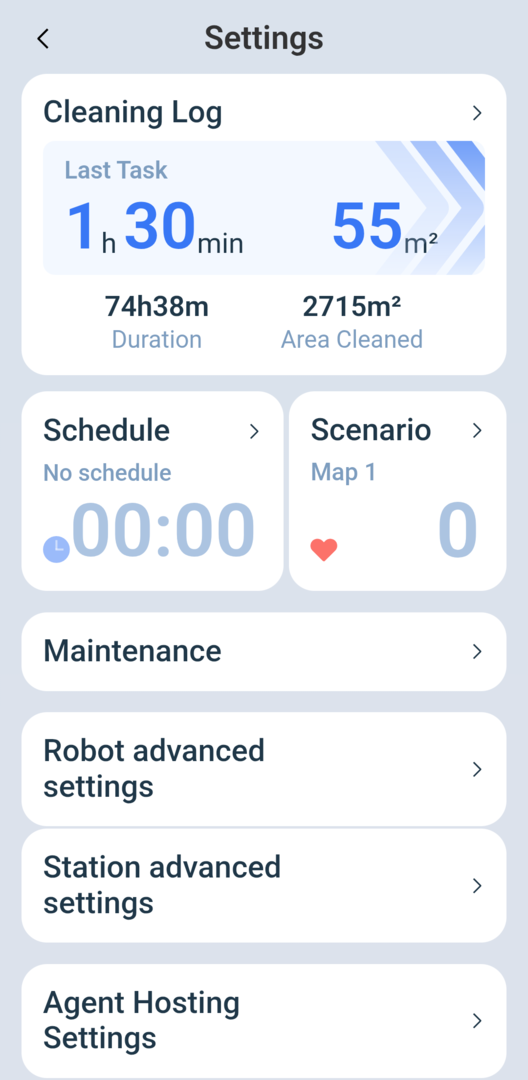
Below is an overview of the settings that can be adjusted for both the robot and the dock:
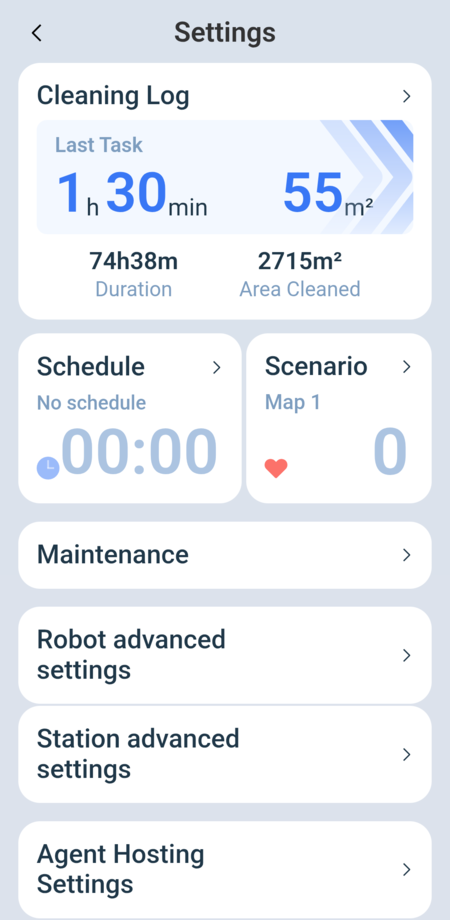
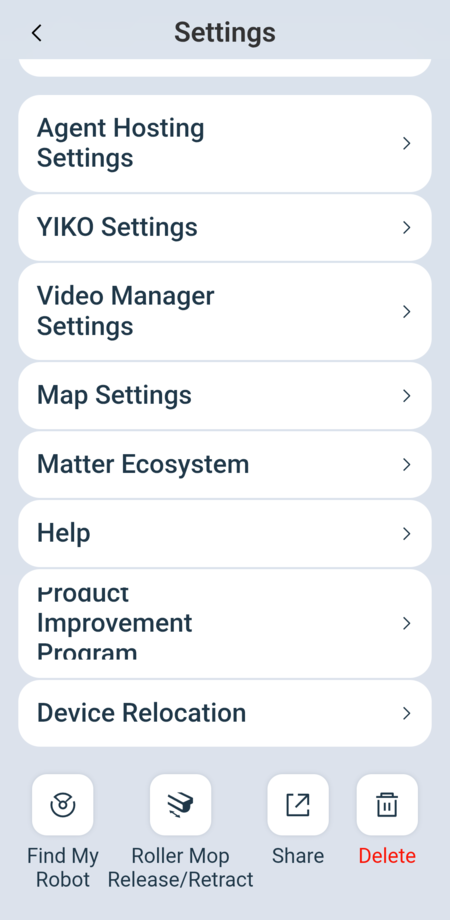
The main menu then contains settings specifically for the robot itself:
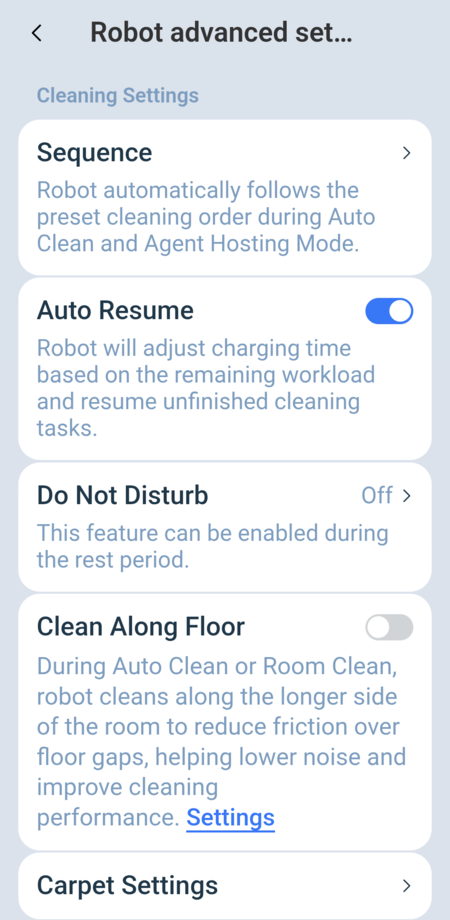
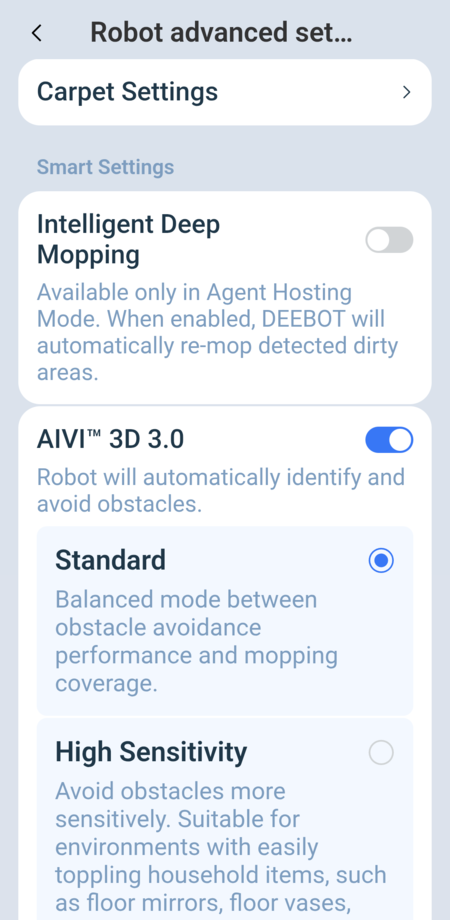
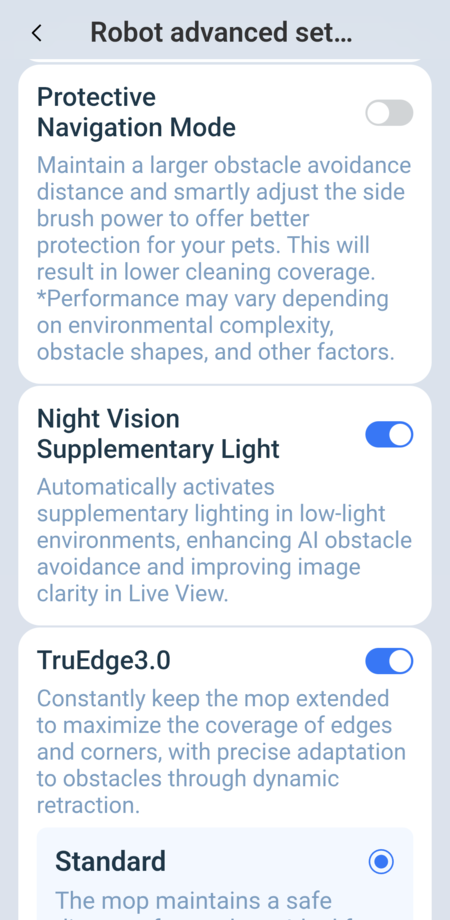
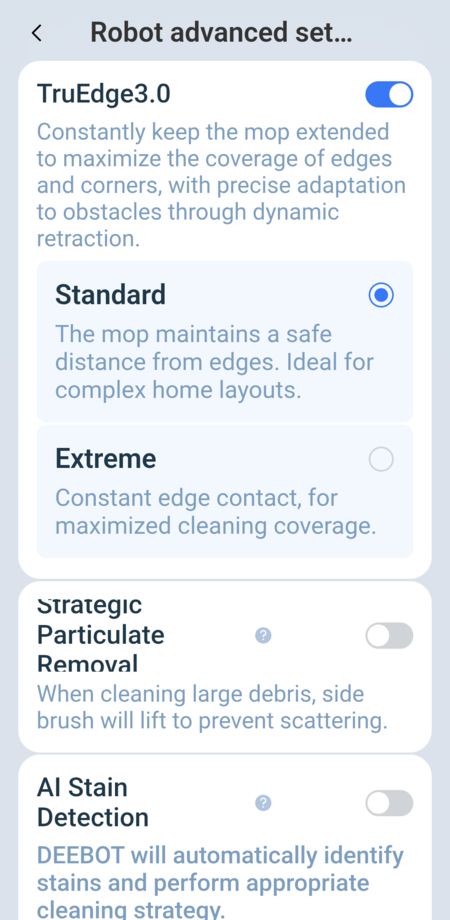
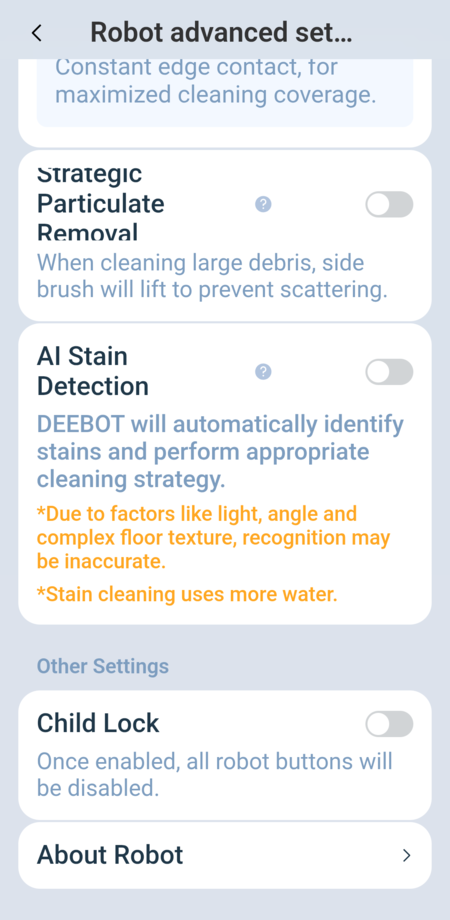
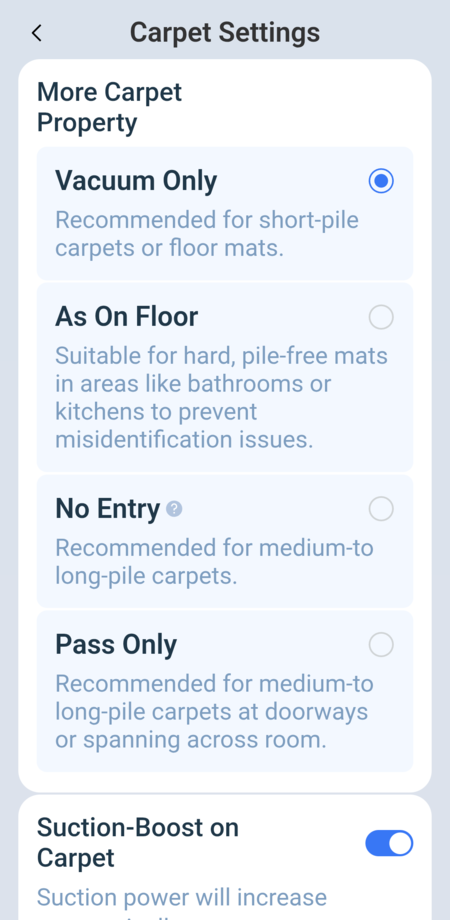
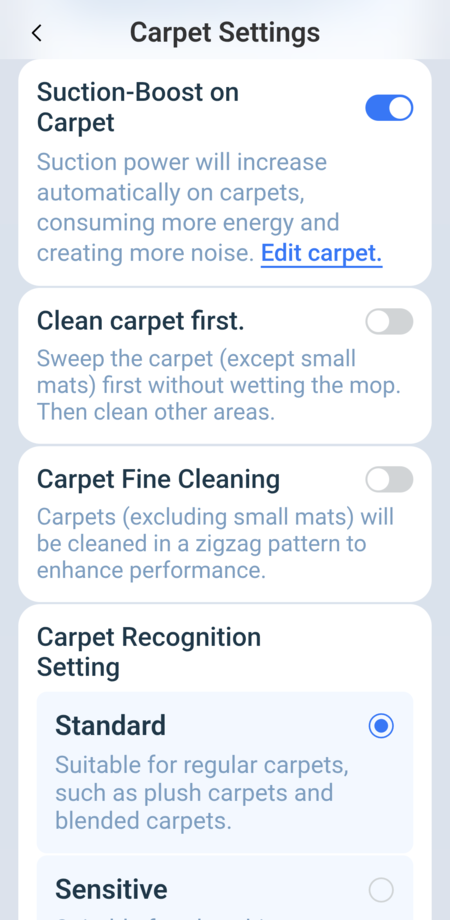
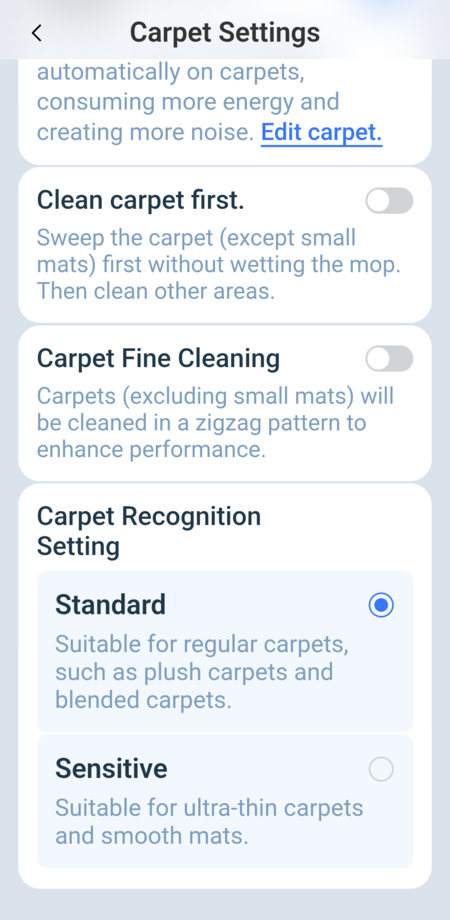
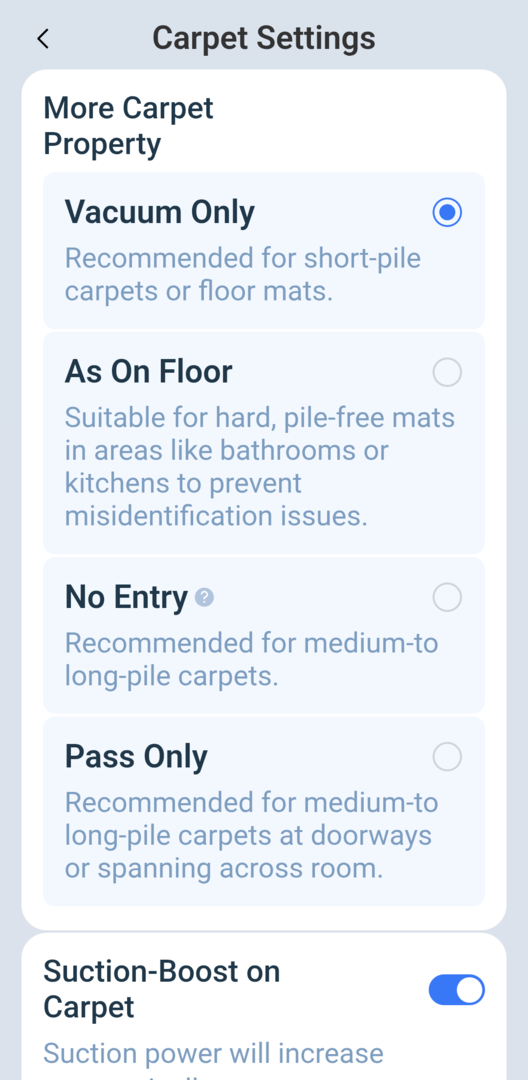
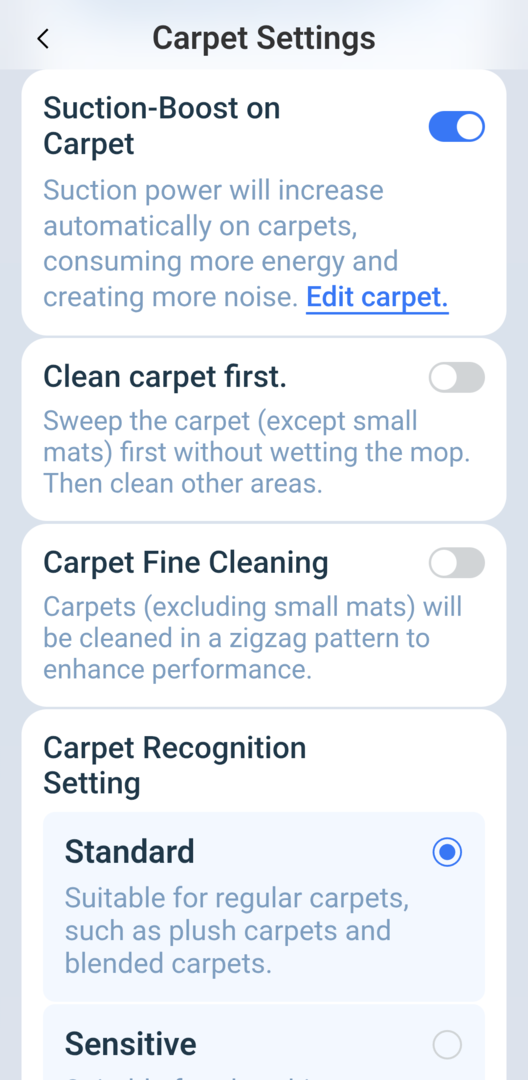
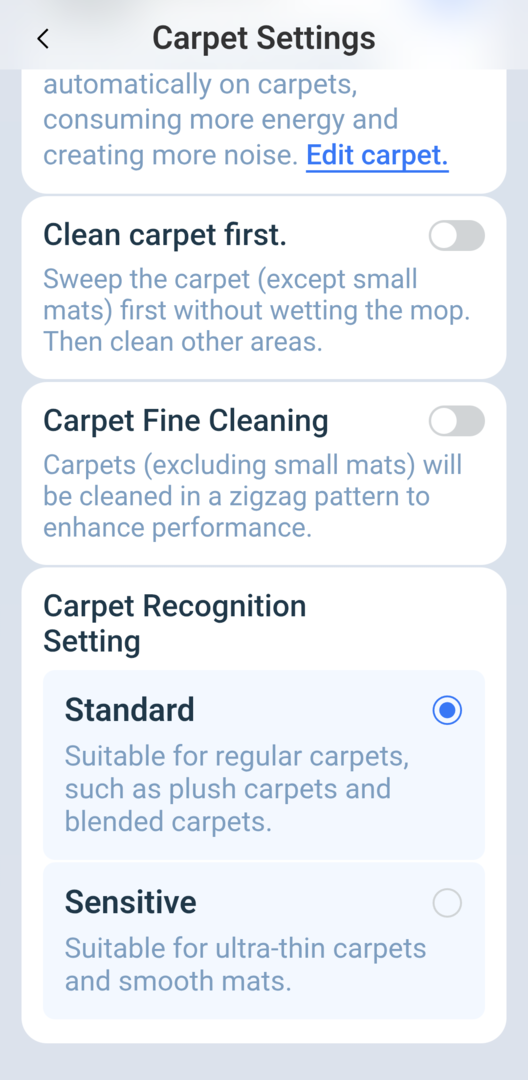
And here are the settings related specifically to carpets:
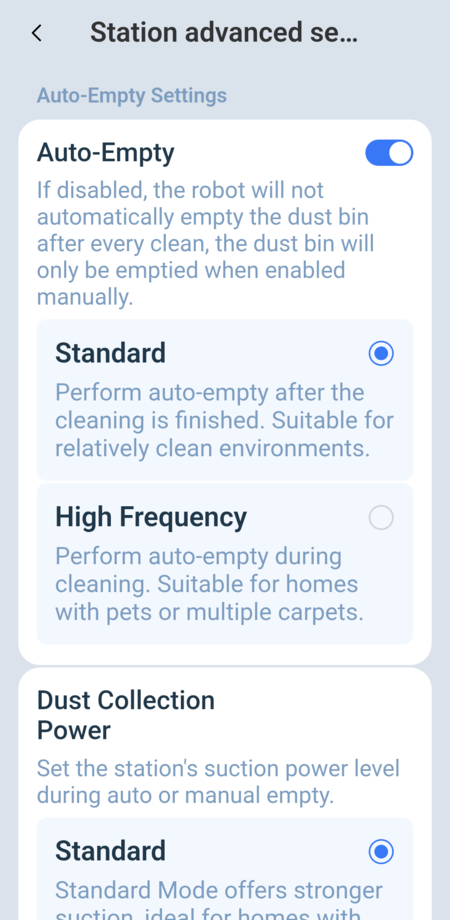
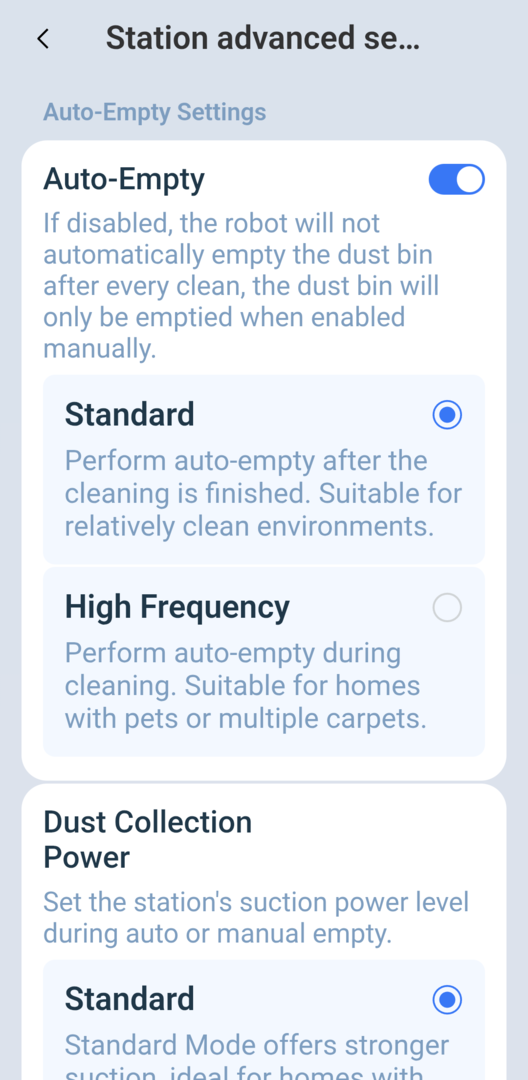
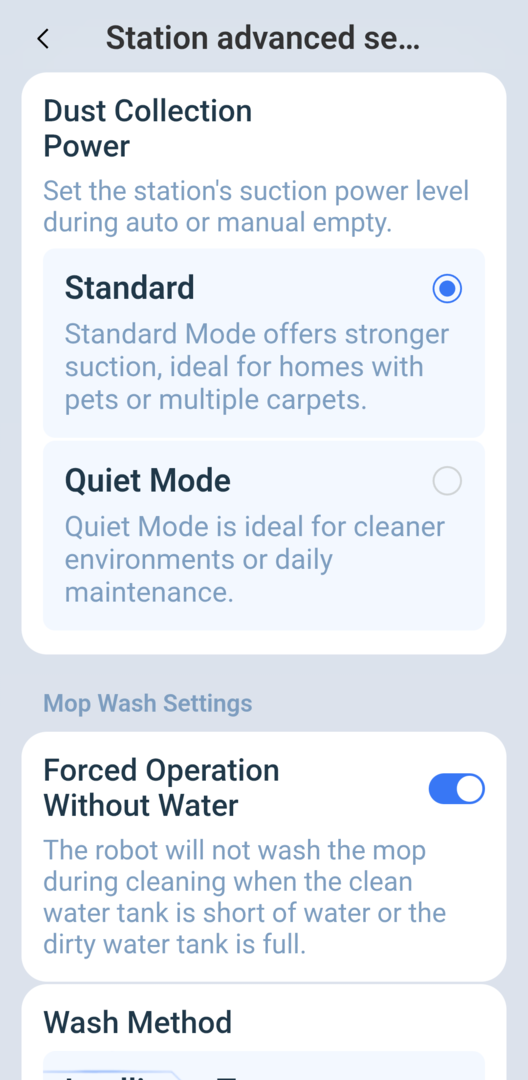
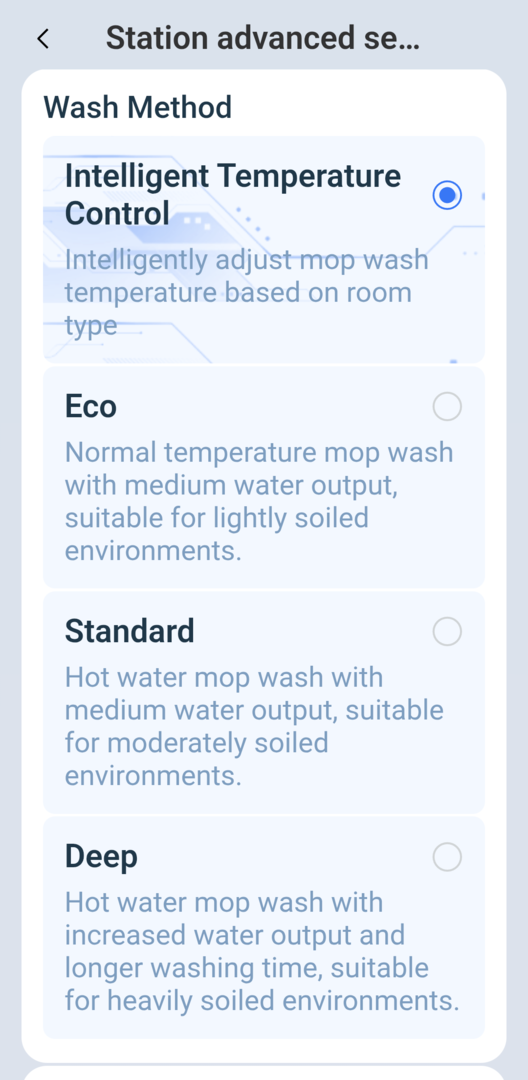
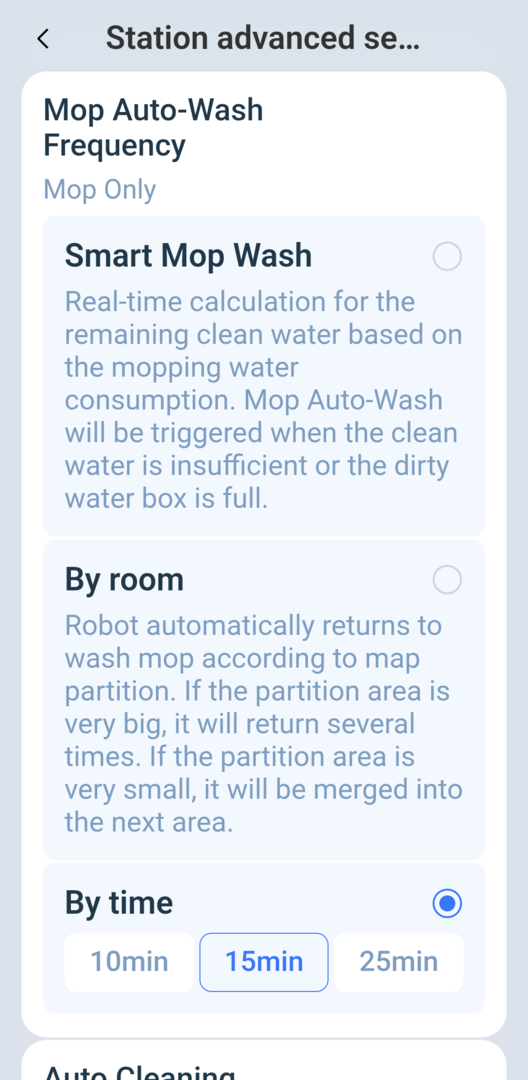
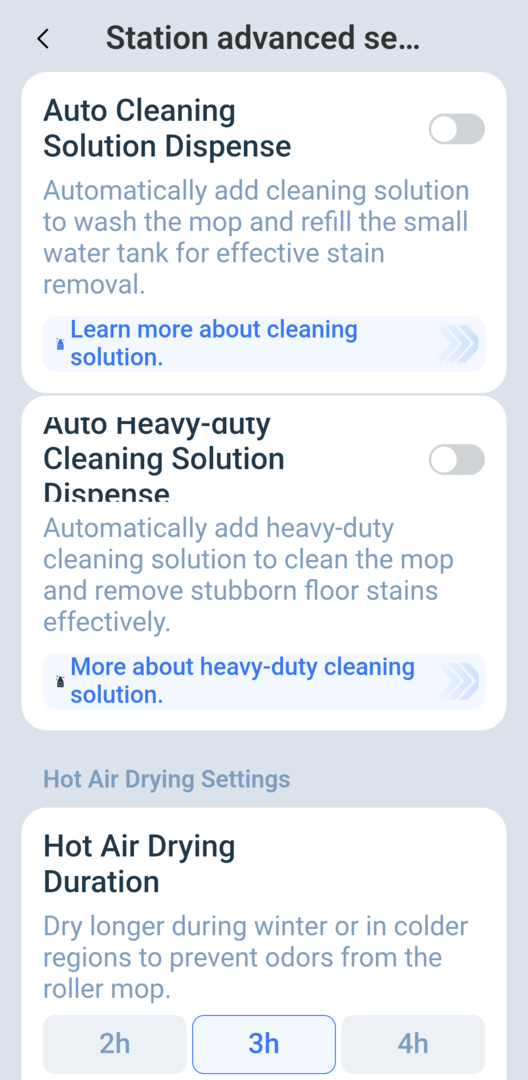
And then there are the dock settings...
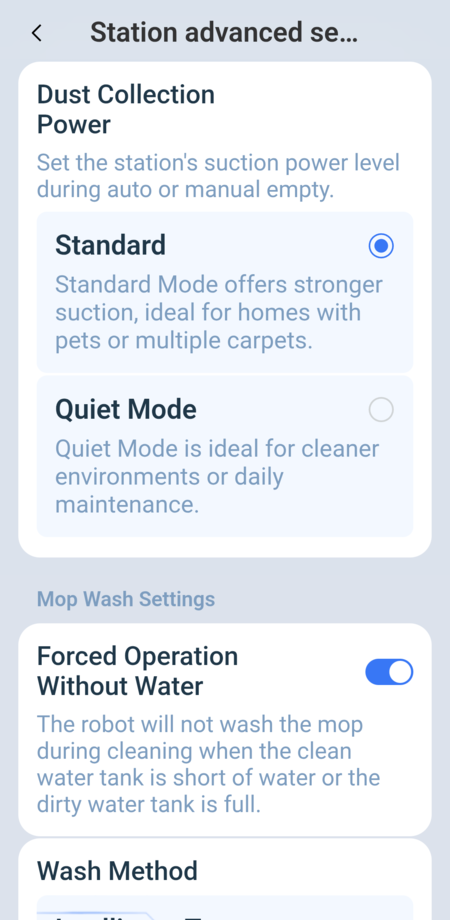
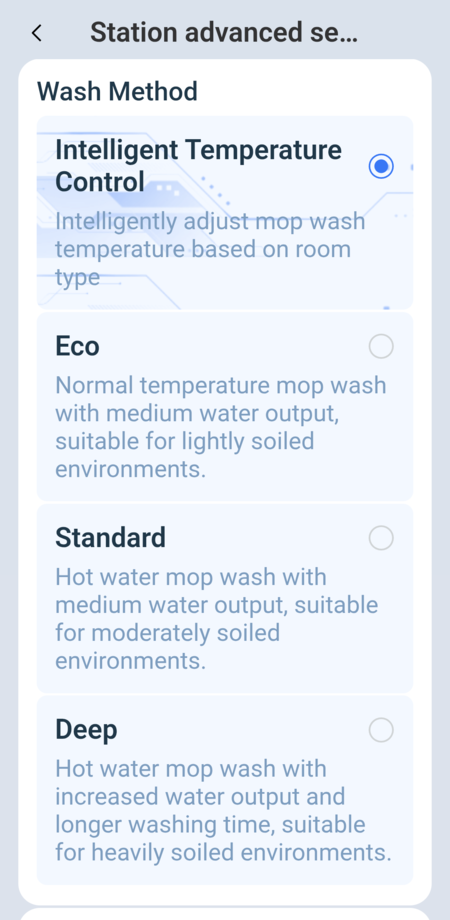
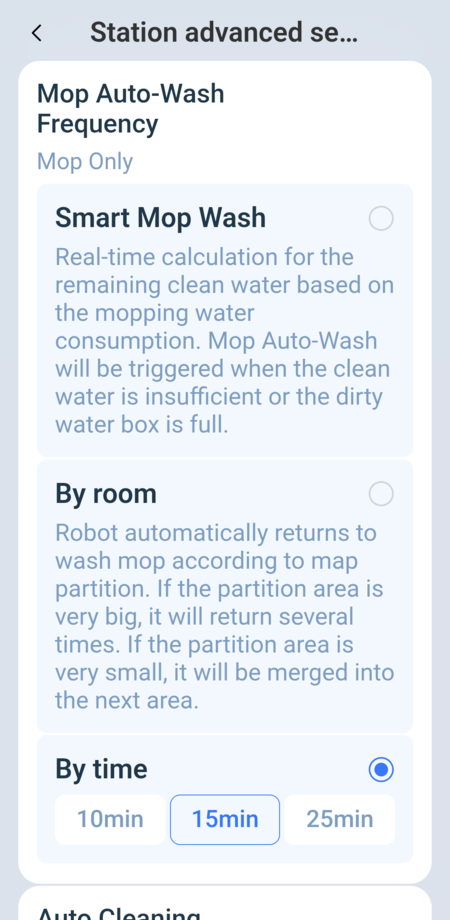
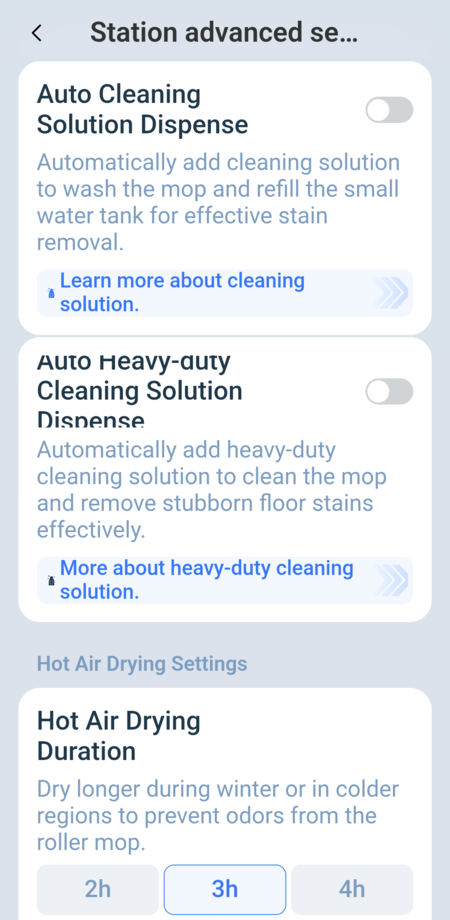
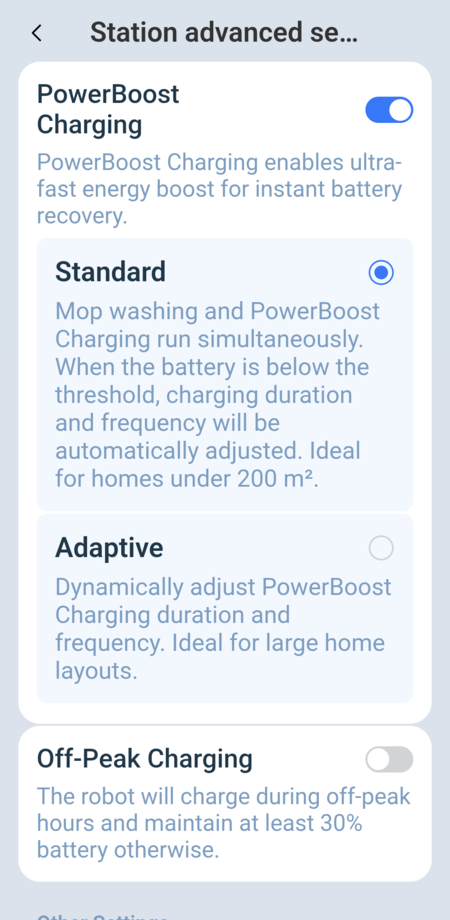
For ordinary mortals like us, using the Ecovacs app is nevertheless a somewhat heavy experience. Thankfully, the most important feature - sending the robot out to clean the home exactly the way you want - has been implemented in a relatively straightforward and clear manner.
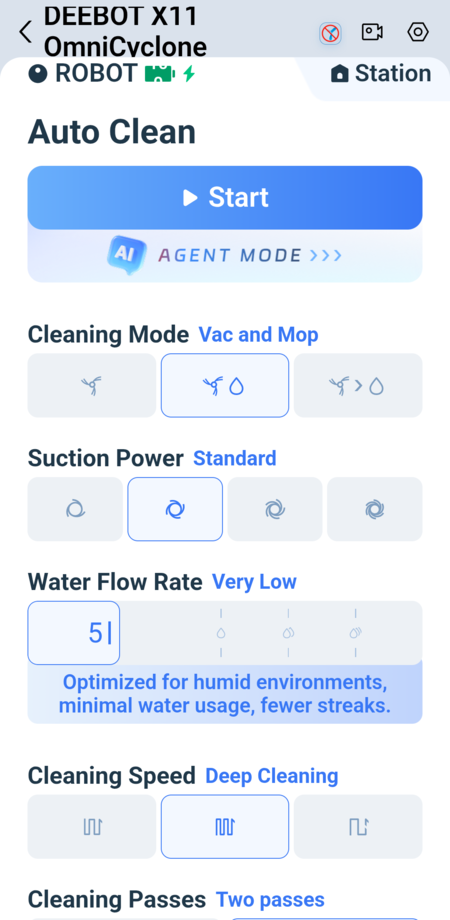
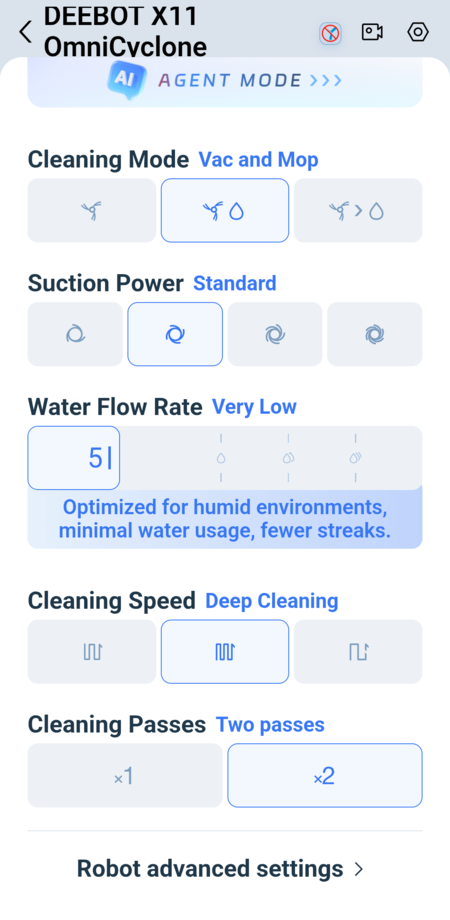
And of course, the extremely detailed level of customization is itself a good thing: when starting a cleaning session, the user can fine-tune virtually every cleaning-related setting exactly the way they want.
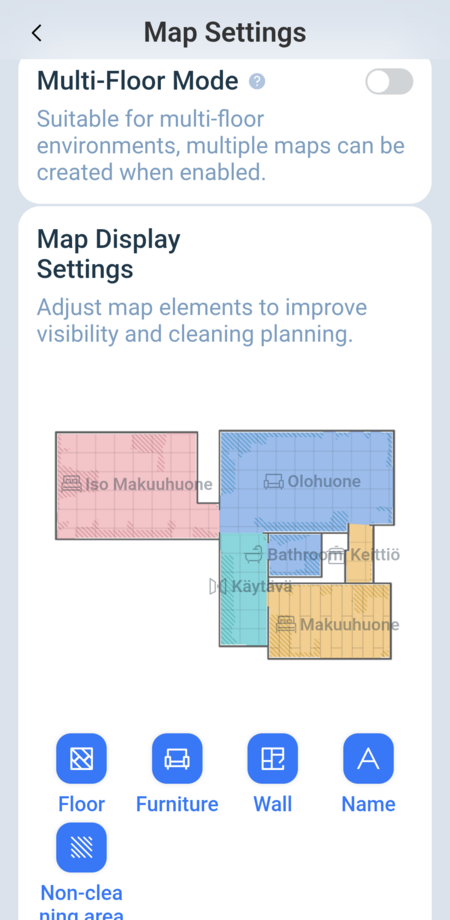
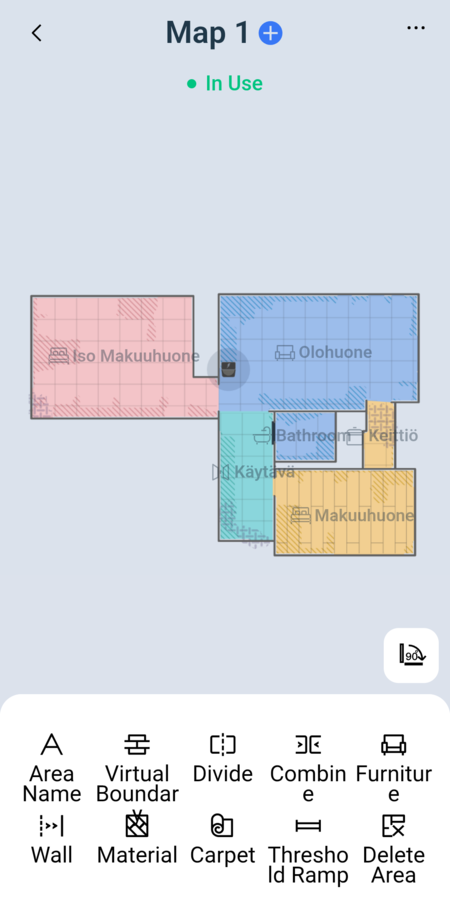
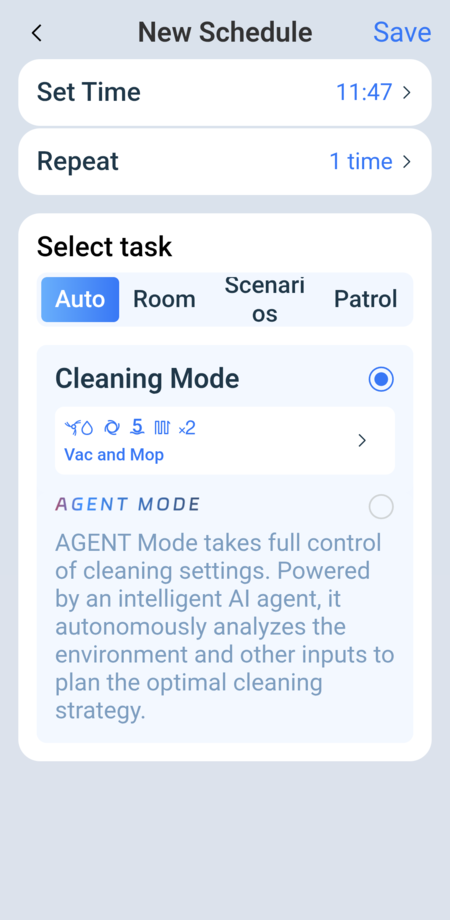
Despite the menu labyrinth and somewhat clumsy translations, the Ecovacs app is actually a fairly capable piece of software - and it genuinely allows precise adjustment of virtually every setting imaginable. And in everyday use, you barely need to open the app at all: once the apartment's cleaning settings have been dialed in properly, the robot is best programmed to clean automatically on a schedule.
Like practically all modern robot vacuums, the Ecovacs can be controlled in three different ways: by pressing the physical buttons on top of the robot itself, through the app, or via scheduled cleaning routines.
Because my own daily routine is not particularly regular, I did not use schedules very much during the test period. And pressing the robot's physical button does not offer a great deal of control over the cleaning mode (it simply cleans the entire apartment using default settings), so I mostly launched cleaning sessions through the app. For users with a more predictable routine, I would absolutely recommend using schedules so that the robot cleans the home regularly - preferably several times a week.
Cleaning can be customized in great detail. You can select specific rooms from the map and even assign each room its own cleaning profile if desired - or simply clean the entire home using the same settings throughout. The Ecovacs X11 is also relatively quick at cleaning, even when both mopping and the more thorough cleaning modes are enabled.
During cleaning, the robot occasionally returns to the dock to clean its mop roller, after which it resumes cleaning exactly where it left off before the intermediate cleaning cycle.
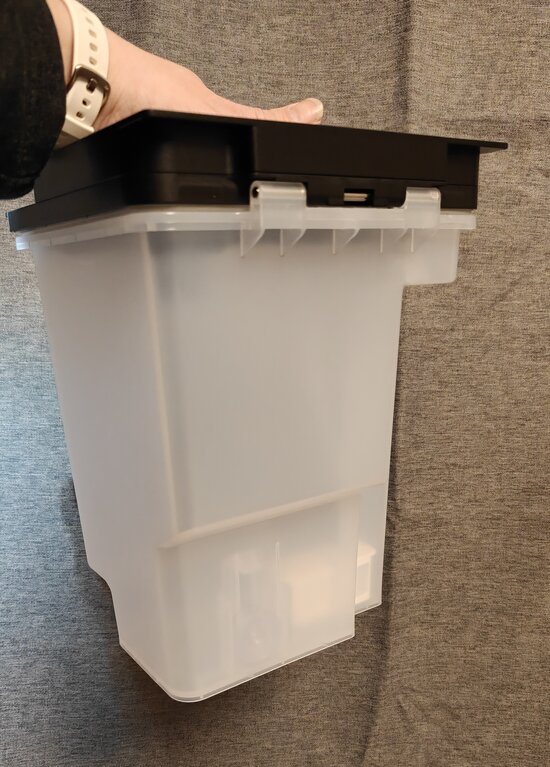
The robot's water usage can also be adjusted with pleasantly fine precision directly from the app settings, which is particularly important with laminate flooring (since laminate floors should not be exposed to excessive moisture). Dirty water removed from the mop roller is collected into its own dedicated tank, as is typical with more premium modern robot vacuums.
Naturally, the Ecovacs detects carpets using its camera system and automatically lifts the mop roller while switching to vacuum-only mode when moving onto carpets - preventing carpets from getting wet during cleaning.
That said, it should be noted that the Ecovacs X11 Omnicyclone cannot leave its mop roller behind at the dock when necessary, because the mop is a fixed part of the robot itself. Many competing models that use rotating mop pads instead of a roller-style mop can detach and leave the entire mopping module at the dock during vacuum-only cleaning sessions.
Because the mop roller is always attached to the robot, I would not recommend the Ecovacs for homes with thick, plush carpets. Even though the robot can raise its chassis upward, the mop roller would still inevitably drag along the surface of thick carpets even when operating in vacuum-only mode.
Cleaning itself is carried out systematically, and in fact, the cleaning pattern used by the robot can also be selected manually. Once cleaning is finished, the robot returns to its dock and immediately empties its internal dustbin into the larger dust container located inside the dock.
After emptying the dustbin, the robot begins washing its mop roller, a process that takes several minutes. This is followed by a drying cycle lasting several hours, during which a faint humming sound can be heard from the dock as airflow is used to dry the mop. The drying duration can also be adjusted, although for hygiene reasons - particularly to prevent bacteria and mold growth - it is naturally recommended to let the drying cycle run as long as possible.
For robot vacuums costing well over a thousand euros, the single biggest factor separating the good from the bad is naturally obstacle avoidance - and the robot's ability to stay out of trouble.
We test this very simply: every robot vacuum we review gets used for several months in an ordinary Nordic home, with absolutely no effort made to clear obstacles from the floors or block off problematic areas.
And this time was no different.
And this is where the Ecovacs X11 Omnicyclone genuinely surprised us positively. Previous Ecovacs models we've tested over the years have specifically struggled with obstacle avoidance and managed to get themselves stuck in all kinds of bizarre situations during the testing period.
But the Ecovacs Deebot X11 Omnicyclone was from a completely different planet in this regard. During the entire lengthy test period, the robot only got stuck a couple of times - and even those incidents happened during the very beginning of testing. The robot received multiple firmware updates during the review period and while it's obviously impossible to say exactly what the updates changed, the Ecovacs X11 didn't get stuck even once during the final two months of our testing.
In other words: it didn't eat floor cables, didn't crumple rugs, didn't get tangled in the legs of a clothes rack and didn't consume shoelaces.
Practically a perfect performance.
Really, the only even remotely noteworthy criticism regarding obstacles is that the Ecovacs can only climb over fairly low thresholds. It occasionally managed to enter the bathroom, which has a threshold about 2.8 cm high - but most of the time it failed.
As far as obstacle avoidance goes, the Ecovacs X11 was an excellent robot vacuum.
The Ecovacs X11's biggest innovation in the robot vacuum world is, of course, its bagless dust collection system in the docking station. While it may sound like a fairly minor detail, it actually matters quite a bit.
Robot vacuums themselves have never used dust bags - only dust containers. But ever since robot vacuums gained self-emptying technology, their docking stations have almost universally relied on disposable dust bags. These bags look essentially identical to the dust bags used in traditional vacuum cleaners, and the robot simply empties its internal dustbin into them after cleaning.
But that's where the problem lies.
First of all, everyone knows how annoying it is to buy dust bags for traditional vacuum cleaners. You need to know the exact model and then hope your local store happens to stock compatible bags. Otherwise you end up ordering them online and paying shipping fees.
And the problem becomes even worse with robot vacuums, since far fewer households own them compared to traditional vacuums - meaning lower demand for replacement bags and a much smaller chance that your local supermarket carries the correct ones for your specific self-emptying robot vacuum.
And naturally there's also the environmental aspect: it's somewhat absurd to waste resources manufacturing disposable dust bags when the entire system can be implemented without single-use consumables in the first place.
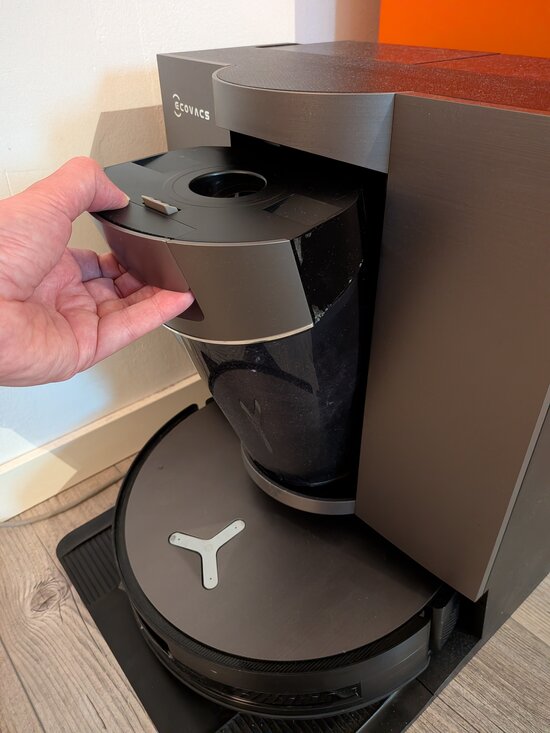
Ecovacs' solution works almost exactly like the system used by any bagless traditional vacuum cleaner: inside the docking station there's a cylindrical plastic container into which the robot empties its internal dustbin. The container has a capacity of 1.6 liters. Once it fills up, you simply remove it from the dock, carry it to the trash bin and empty it. Very simple.
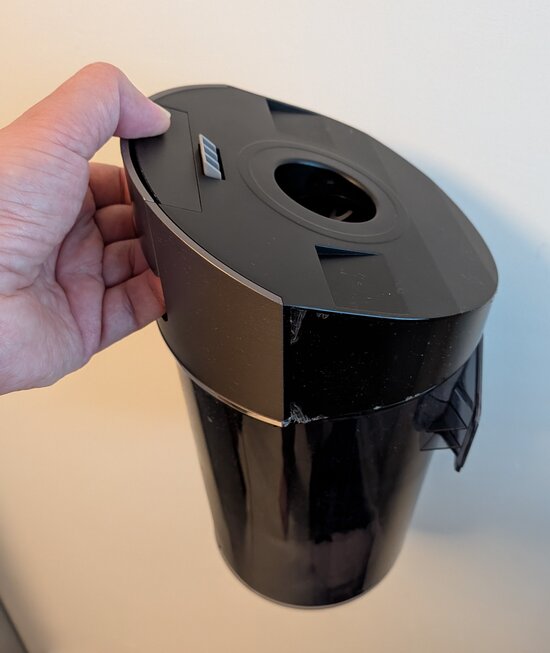
One interesting side effect of the fixed dust container is that, for some reason, it feels like it fills up faster than a traditional dust bag, even though the nominal capacity is similar. In practice this wasn't really a problem, since during our several-month-long test we only had to empty the container exactly twice.
Still, especially in households with pets, the bagless approach will almost certainly make long-term financial sense even with self-emptying robot vacuums.
For many readers whose experience mainly comes from old robot vacuums from the 2010s, it may come as quite a surprise that actual cleaning performance is no longer a major differentiating factor between high-end robot vacuums. That's because modern robot vacuums costing around a thousand euros are simply all extremely good at the core task of cleaning.
And that was also true for the Ecovacs Deebot X11 Omnicyclone. When used "properly" - meaning the robot was allowed to clean the apartment continuously, several times a week - the floors remained consistently very clean throughout the entire testing period.
Our testing period conveniently covered both winter and spring, meaning the biggest challenge came from mud and road grit carried indoors by shoes near the entrance. Even this proved no issue for the Ecovacs, and the entryway stayed impressively clean throughout the test.
The robot's extendable mop roller and highly capable side brush ensured that even corners and edges along walls stayed clean during the entire review period.
So as far as cleaning performance goes, there really wasn't anything to complain about with the Ecovacs.
Although Ecovacs performed excellently in obstacle avoidance and the cleaning performance was, as expected in this price range, outstanding, the robot was not entirely without flaws.
During our test period, we encountered a strange bug in the robot's internal software: at one point, the Ecovacs started cleaning the apartment normally, carefully driving around every room and corner, but it simply did not vacuum anything. In other words, the robot's suction system had somehow become completely disabled and the robot merely drove around aimlessly, eventually returning to its dock and happily announcing that the cleaning had been completed.
We tried to solve the issue through the settings, cleaning modes and various other tweaks.
In the end, the old classic IT trick was the only thing that helped: we powered the Ecovacs X11 completely off for a couple of minutes and then turned it back on. After that, the issue disappeared - only to return again roughly a month and a half later. But when it reappeared, we already knew that a reboot fixed the problem.
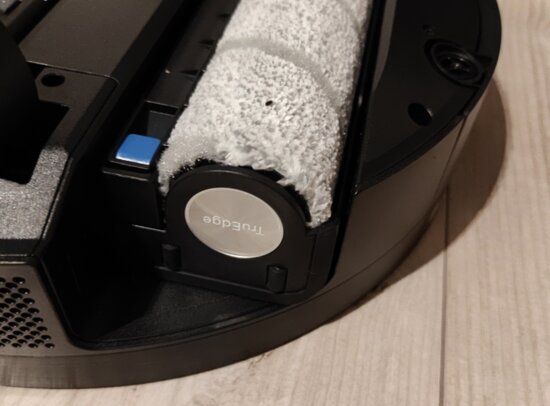
Another minor issue was related to the robot's roller-style mopping system. First of all, the roller mop clearly does not get cleaned quite as effectively by the dock's self-cleaning system as the more common rotating mop pads do. In other words, in our opinion the Ecovacs roller mop never felt quite as clean after washing as traditional mop pads typically do. This did not show in the actual cleaning performance - which we considered very good - but it was still a somewhat odd observation.
A third small but annoying issue emerged right at the end of our test period: some component inside the robot started producing a mechanical squeaking noise during operation. We tried cleaning the robot and removing various parts, but our patience eventually ran out before we could determine exactly where the squealing noise - especially noticeable while mopping - was coming from. The issue may however be related to a motor gear problem that has also been observed in some other Ecovacs robot vacuums.
Overall, the Ecovacs Deebot X11 Omnicyclone turned out to be a very positive surprise. In particular, the bagless dust container in the docking station was a genuinely welcome innovation - something we have been hoping to see in robot vacuums for quite some time already. Especially in households with pets, the cost and hassle of buying replacement dust bags has been a significant annoyance.
Additionally, the X11's obstacle avoidance performance was absolutely excellent, clearly outperforming most competitors in the same price range in this area. We would feel perfectly comfortable leaving the robot cleaning the apartment even during a long vacation, without worrying that it would get tangled in a forgotten charging cable or shoelaces on the floor.
That said, the X11 Omnicyclone is not quite a perfect package. The currently trendy roller mop design used by several manufacturers did not fully convince us based on this first experience. In addition, Ecovacs cannot leave the mop roller behind in the docking station, which means we do not consider this robot suitable for homes with thick, high-pile carpets.
The somewhat confusing smartphone app with its AI-generated translations, along with the strange firmware bug, were also unfortunate blemishes in an otherwise excellent overall package.
So while the Ecovacs X11 Omnicyclone came very close to being an outstanding robot vacuum in many ways, a couple of small issues do somewhat reduce its appeal.
In this price category - well above the $1000/€1000 mark - there are naturally plenty of excellent robot vacuum alternatives available, each with their own strengths.
Personally, I would highlight a few other robot vacuums we have previously reviewed, all of which can also mop floors, avoid obstacles and empty their own dust containers automatically.
First, I would mention the Roborock Saros 10, which performed excellently in our review and whose price has already started to fall to a somewhat more attractive level. Comparing these two models, the Saros 10 beats the Ecovacs in software stability and usability. In addition, the Saros is better suited for homes with thick carpets because Roborock can leave its mop pads behind in the docking station when necessary.
On the other hand, the Ecovacs offers the bagless docking station, which is absolutely a strong long-term selling point. Additionally, based on our lengthy testing periods, Ecovacs' obstacle avoidance felt just slightly more reliable and dependable than that of the Roborock Saros 10.
Another comparison point would be the Dreame X50 Ultra whose price has also dropped noticeably below its launch pricing in recent months. The Dreame X50 Ultra surpasses the Ecovacs by being able to climb significantly taller thresholds and by being capable of leaving its mop pads behind in the dock, making thick carpets much less of an issue. Ecovacs, meanwhile, counters with its own trump card: the bagless docking station.
Both models performed excellently in obstacle avoidance, but the software experience on both is clearly more chaotic than the one offered by the aforementioned Roborock.
A third, noticeably cheaper alternative would be the Roomba 505 Combo, which we reviewed earlier in 2026. Both robots performed very well in obstacle avoidance, although I would still say the Ecovacs has a very slight edge in this area. Neither model can leave its mop system behind in the dock, meaning neither is particularly suitable for homes with thick carpets. Ecovacs also beats the Roomba with its bagless technology and significantly more versatile customization options.
Despite their similarities, I personally consider the Ecovacs to be clearly the better robot vacuum of the two - but at the time of writing (05/2026), the Roomba was available for several hundred euros less than the Ecovacs. Whether the Ecovacs is actually worth several hundred euros more is ultimately something every buyer must decide for themselves.

The Ecovacs X11 Omnicyclone was a very convincing robot vacuum overall and quickly became one of my personal favorites. However, its small software bugs and somewhat confusing smartphone app inevitably hurt the overall experience - especially considering that the price still remains above one thousand euros (05/2026).
Additionally, the fact that the mop roller cannot be left behind in the docking station makes the Ecovacs poorly suited for homes filled with thick carpets.
For these reasons, I ended up deducting one full star from the final score, because at this price level a robot vacuum should, in my opinion, feel highly polished and very close to perfect overall. And despite all its strengths, the Ecovacs X11 Omnicyclone ultimately did not quite reach that level.
But even then, we complained about one particularly silly design choice... Why on earth does the larger dock-mounted dust container rely on disposable dust bags, when traditional canister vacuum cleaners largely abandoned them sometime in the early 2010s? Buying dust bags is already irritating enough with conventional vacuums, but with robot vacuums it can eventually become nearly impossible as models age and compatible dust bags may only be available from questionable Chinese online stores.
Now, that rather ridiculous problem finally has a solution. We got our hands on Ecovacs' new flagship robot vacuum, the Ecovacs Deebot X11 Omnicyclone, launched around the turn of 2025/2026, where the dock's dust bag has been replaced by a fixed large-capacity dustbin.
At the time of review, the Ecovacs X11 Omnicyclone carries a fairly hefty $1,000/€1,200 price tag, but it also includes essentially everything you'd expect from a modern high-end robot vacuum: camera-based obstacle avoidance, mopping functionality, self-emptying, and automatic mop washing.
But compared to most competitors, the robot also introduces two notable new features: the previously mentioned bagless dock dustbin and the latest trend in robot vacuums, the so-called aqua roller-style mopping system.
We tested the Ecovacs for three months in a typical Nordic apartment to see how the robot would handle the challenges of a Northern Europe's winter and early spring, complete with gravel and sand dragged indoors from icy sidewalks.
Table of contents
- Design and features
- Technical specifications and pricing
- Mobile app
- Usage
- Obstacle avoidance
- Bagless dustbin
- Cleaning performance
- Issues
- Summary
- Alternatives
- Pros
- Cons
- Verdict
Design and features
Visually, the Ecovacs X11 Omnicyclone looks very much like any modern robot vacuum: a relatively low-profile circular disc with a couple of physical buttons on top.
The robot itself features a dark gray matte finish and Ecovacs' familiar three-pronged logo, which also houses the robot's physical buttons.
However, the matte gray surface on top is actually a removable cover panel that reveals more of the robot's internal hardware underneath. In practice, there's rarely any need to remove the panel, but it does provide access to the robot's internal dustbin and physical power button.
Like other premium obstacle-avoiding robot vacuums, the robot's front houses its cameras along with an auxiliary light that activates when needed. The camera system is used to identify and avoid obstacles on the floor.
Things become more interesting once we flip the robot over. First, it's worth noting that Ecovacs stubbornly sticks to a single main brush design, even though our experience suggests that dual-brush systems generally provide better vacuuming results.
The second surprising detail concerns Ecovacs' side brush. Whereas most robot vacuums use a side brush consisting of three short bristles pointing in different directions, Ecovacs opted for a single flexible rubber-like arm that splits into two at the tip.
And the third noteworthy feature underneath is naturally one of the Ecovacs X11 Omnicyclone's signature selling points: the roller mop (also known as an aqua roller), which has recently become increasingly common among the most expensive mopping robot vacuums.
The cylindrical mop roller rotates similarly to the robot's main cleaning brush. Additionally, on the Ecovacs, the mop roller can extend several centimeters beyond the robot's side, allowing it to reach corners and edges more effectively.
Then there's the docking station itself, which is - as expected in this price range - absolutely massive (without the base plate, the dock measures 38 x 33.5 x 46.5 cm).
At the bottom of the dock sits the robot's parking bay, where it returns after every cleaning cycle. This compartment contains the mechanism used to wash the robot's mop roller, remove dirty water afterward, and dry the roller using warm air.
The same area also houses the mechanism used to empty the robot's internal dustbin into the dock's larger dust container.
On top of the dock are the clean and dirty water tanks. The clean water tank holds 3.2 liters, while the dirty water tank has a capacity of 2.7 liters. Water is heated to 75°C during mop cleaning.
And then, of course, we arrive at the Ecovacs X11 Omnicyclone's biggest selling point: the removable bagless dustbin. At the front of the dock sits a plastic 1.6-liter container that can simply be unclipped and emptied into regular household trash once full.
The fixed dustbin built into the dock solves one of the biggest problems self-emptying robot vacuums have had: it eliminates the need to buy disposable dust bags.
Especially in homes with pets, dust bags can become a significant ongoing expense over time - not to mention the fact that replacement dust bags for robot vacuums are nowhere near as widely available as those for traditional vacuum cleaners.
Ecovacs X11 Omnicyclone specifications and pricing
| Robot width: | 35.3 cm |
| Robot height: | 9.8 cm |
| Robot weight: | 5.3 kg |
| Dock dimensions: | 38 x 33.5 x 46.5 cm (width, depth, height - without base plate) |
| Dock weight: | 10.3 kg |
| Clean water tank: | 3.2 liters |
| Dirty water tank: | 2.7 liters |
| Dock dustbin: | 1.6 liters |
| Suction power: | 19,500 Pa |
| Battery capacity: | 6400 mAh |
| Battery type: | Li-ion |
| Battery life (quiet mode, vacuuming only): | 254 minutes |
| Charging time: | 3 h 10 min (manufacturer claim) |
| Noise level (vacuuming): | 61.8 dBA |
| Noise level (dustbin emptying): | 73.3–80 dBA |
| Mop lift height: | 10 mm |
| Threshold climbing ability: | 24 mm (single threshold), 40 mm for split thresholds |
Smartphone app
Ecovacs' own smartphone app is available for both iPhone and Android (we tested it ourselves on Android), and it is exactly the same on both platforms. The app has been translated into even smaller languages - but unfortunately mostly with the help of AI and not particularly well.
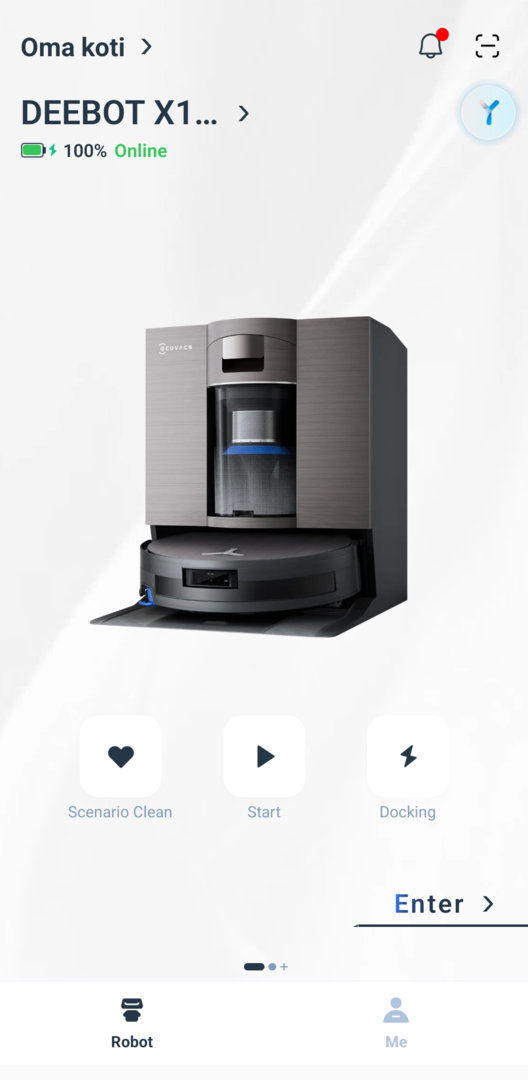
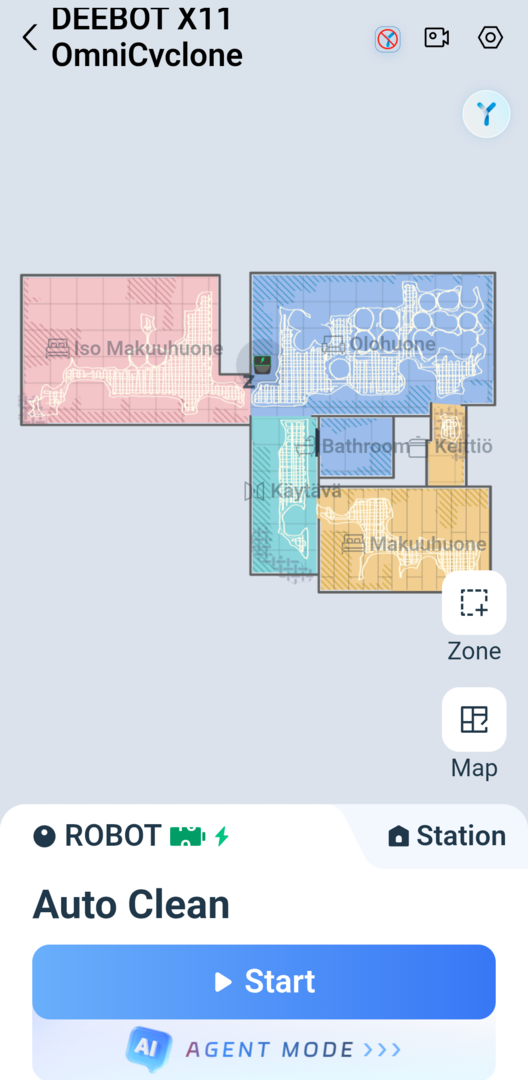
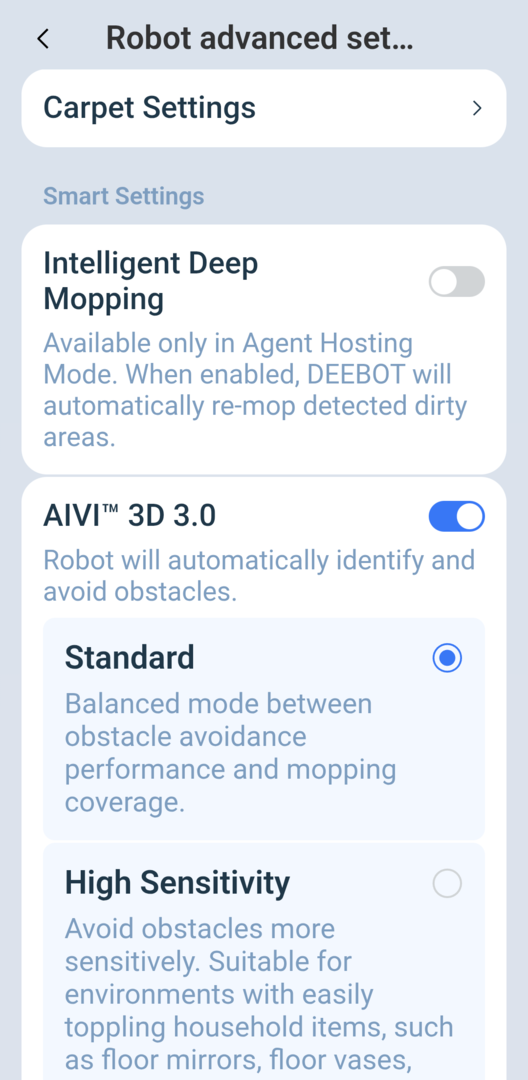
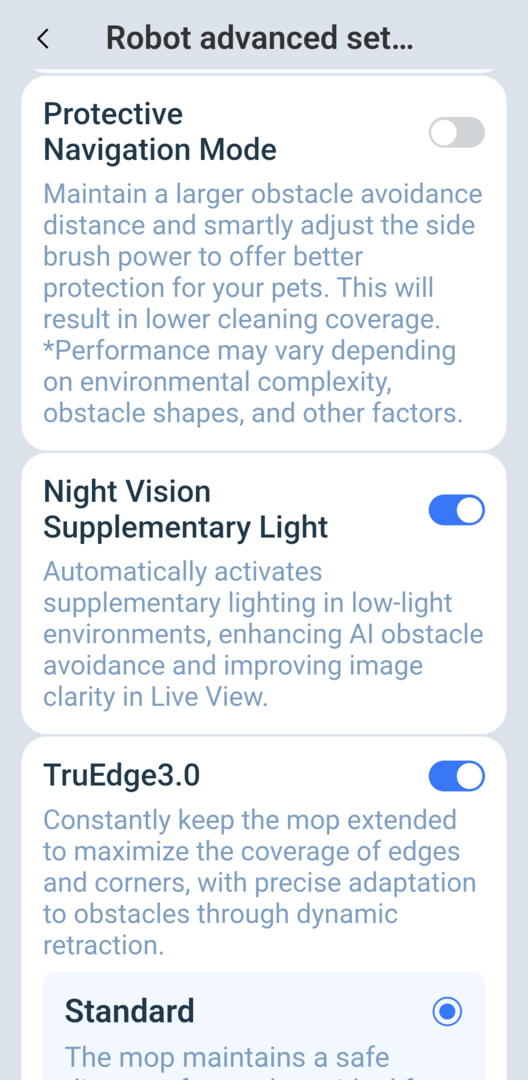
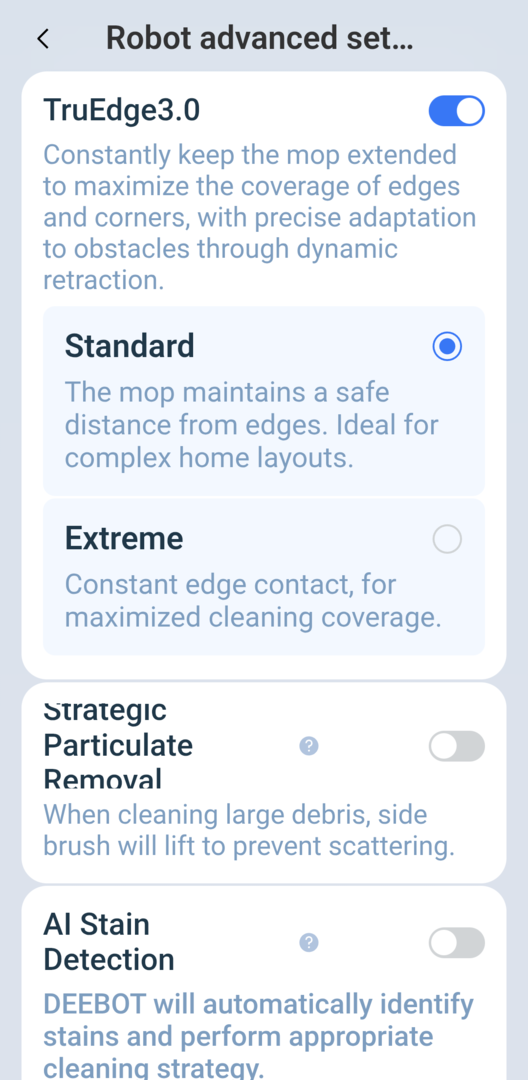
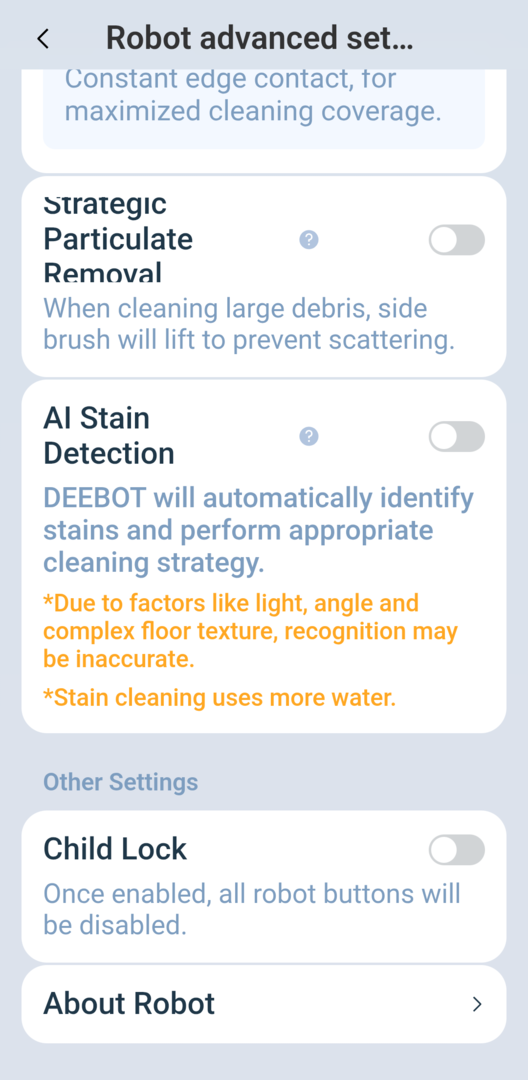
In general, Ecovacs' app follows very much the same logic as the apps used by virtually every other Chinese robot vacuum manufacturer: there is a dizzying amount of functionality and customization available, and various settings are hidden all over the place behind layers of menus. In other words, it will feel very familiar and comforting to anyone who once loved the user interface design philosophy of Nokia phones.
Below is an overview of the settings that can be adjusted for both the robot and the dock:
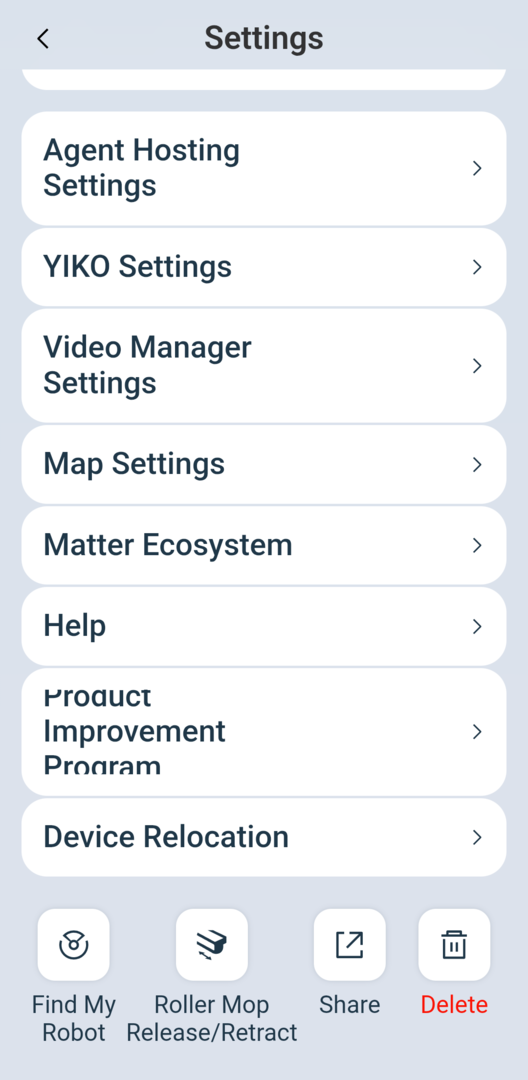
The main menu then contains settings specifically for the robot itself:
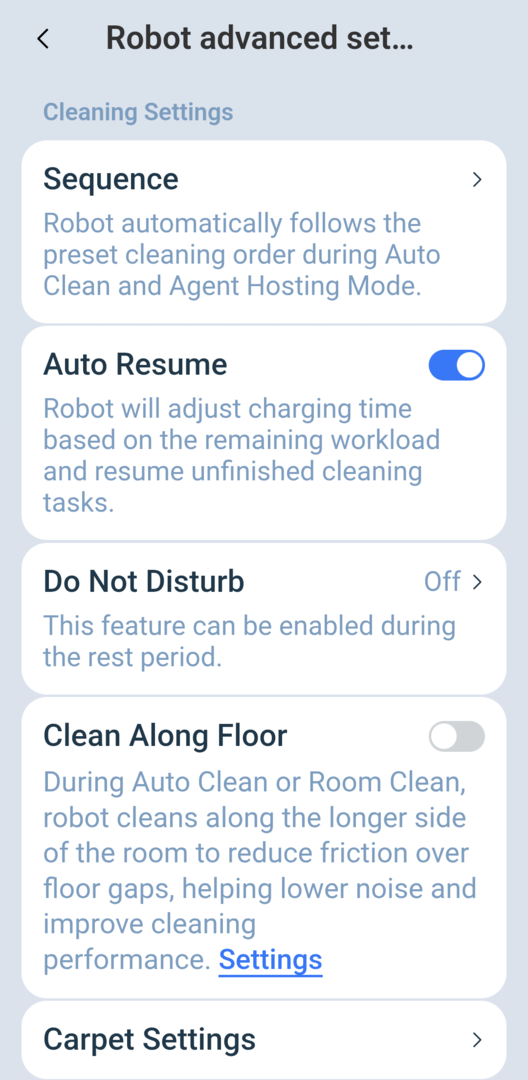
And here are the settings related specifically to carpets:
And then there are the dock settings...
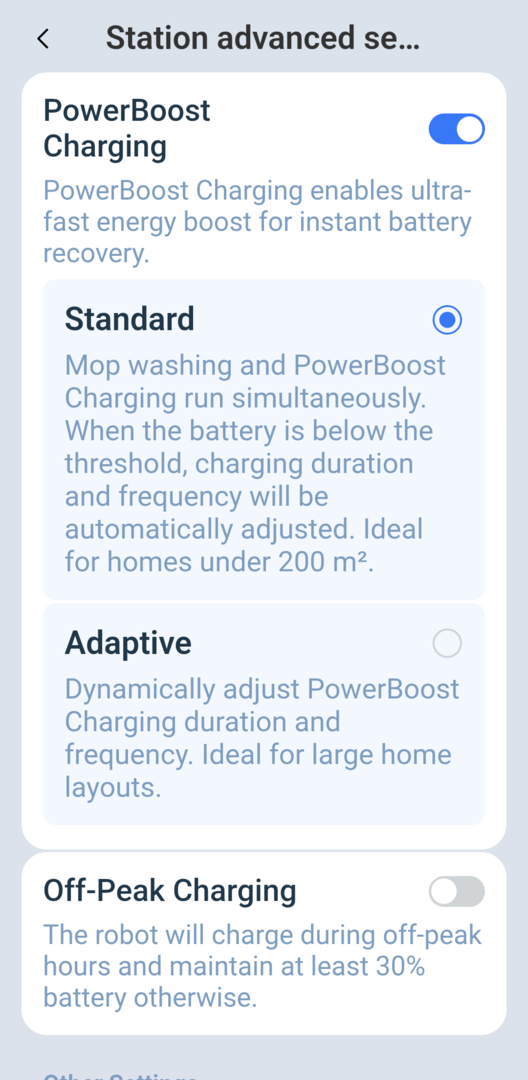
For ordinary mortals like us, using the Ecovacs app is nevertheless a somewhat heavy experience. Thankfully, the most important feature - sending the robot out to clean the home exactly the way you want - has been implemented in a relatively straightforward and clear manner.
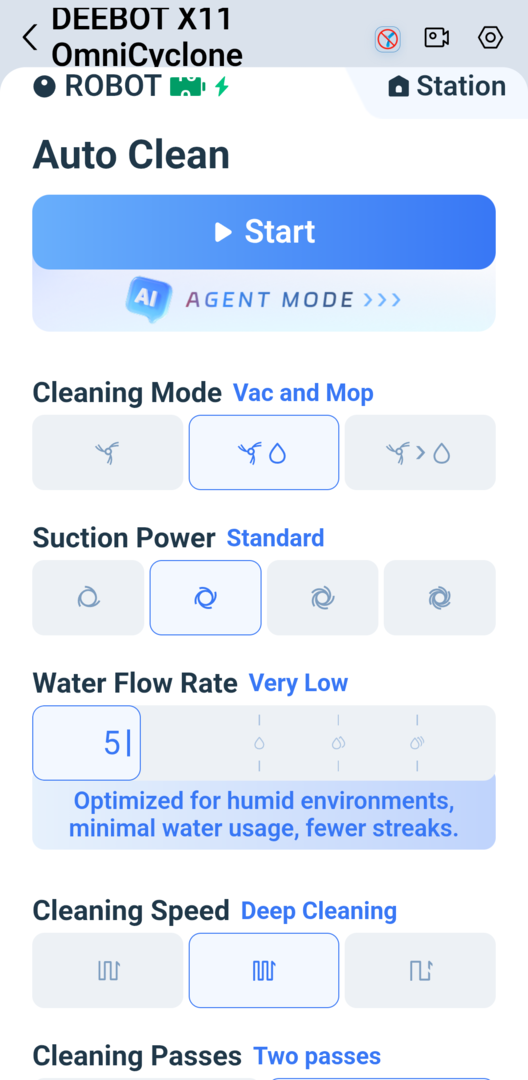
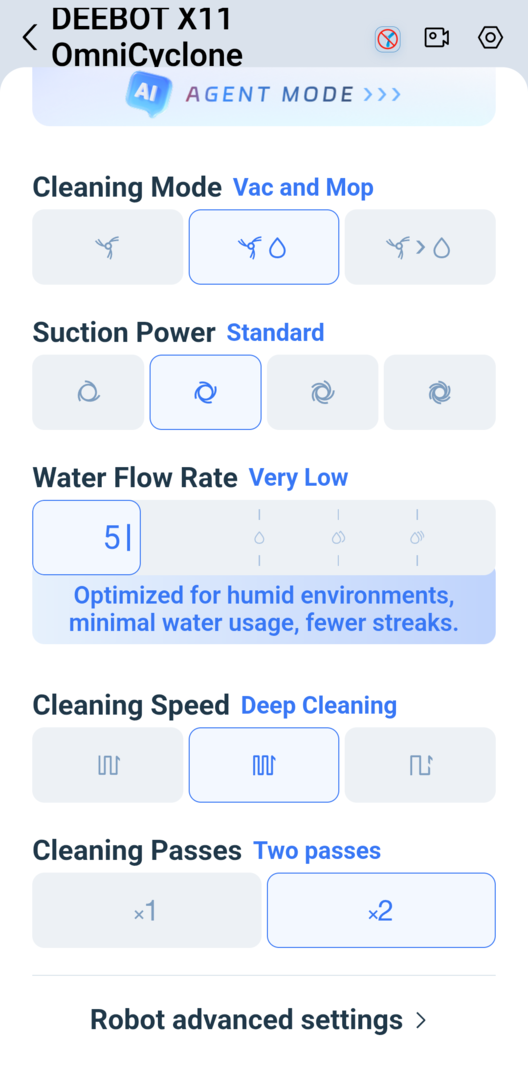
And of course, the extremely detailed level of customization is itself a good thing: when starting a cleaning session, the user can fine-tune virtually every cleaning-related setting exactly the way they want.
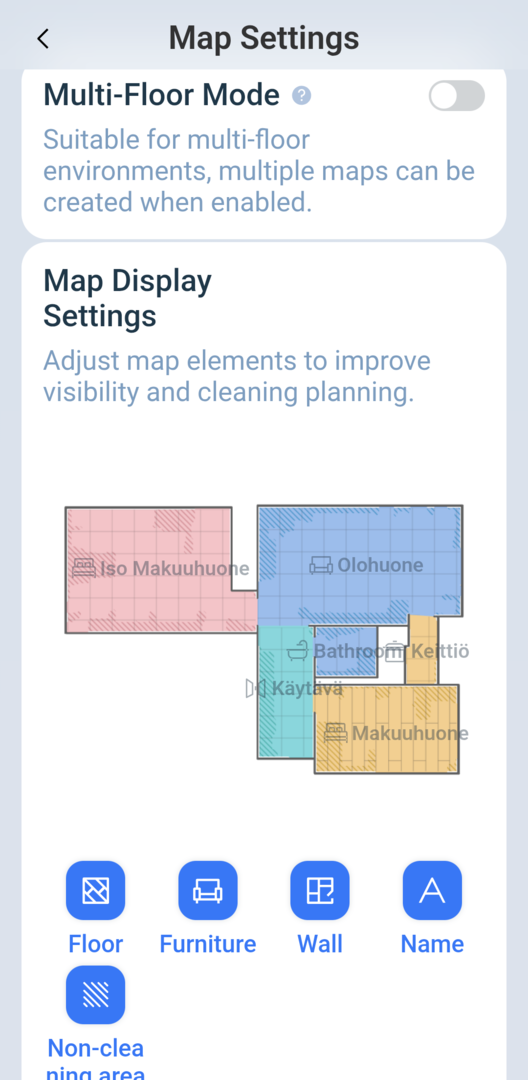
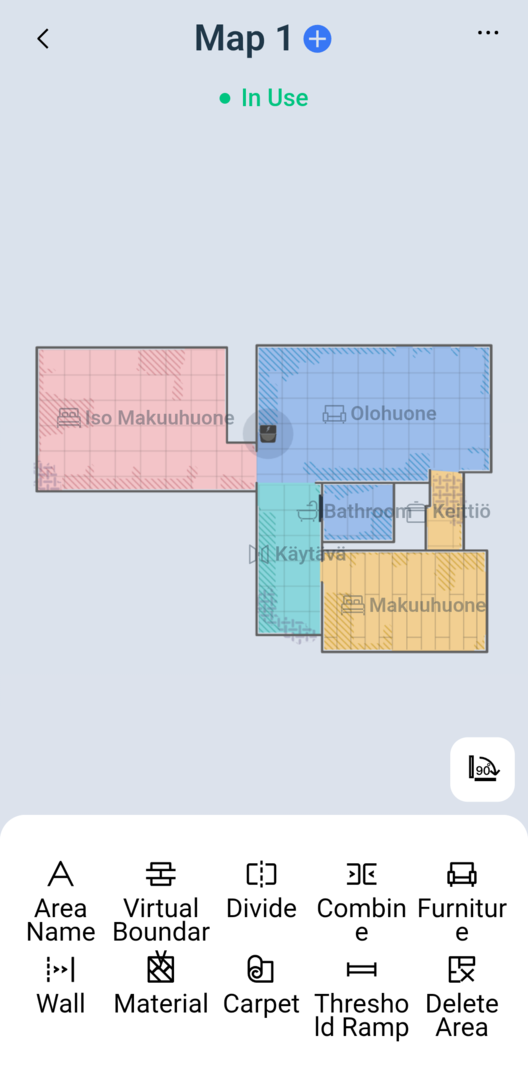
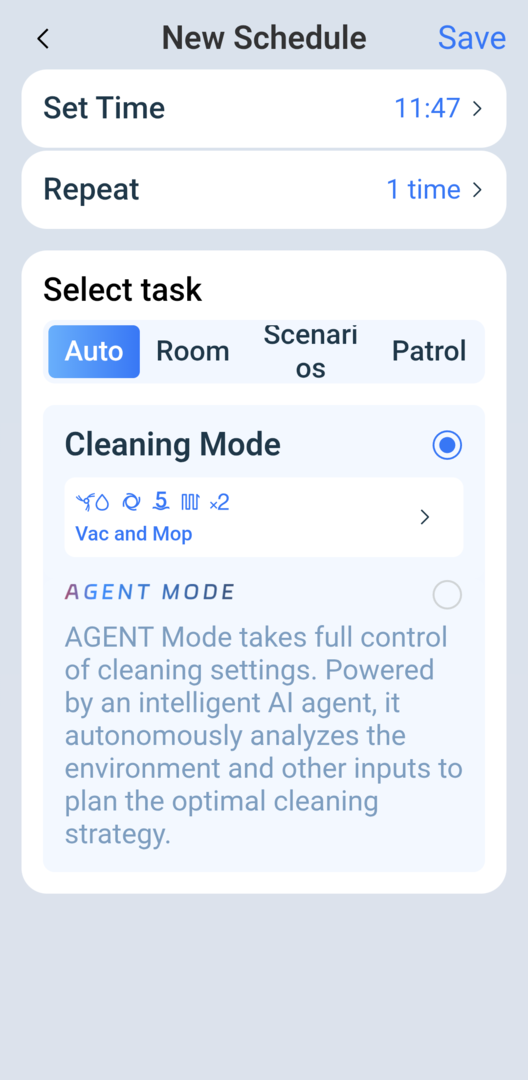
Despite the menu labyrinth and somewhat clumsy translations, the Ecovacs app is actually a fairly capable piece of software - and it genuinely allows precise adjustment of virtually every setting imaginable. And in everyday use, you barely need to open the app at all: once the apartment's cleaning settings have been dialed in properly, the robot is best programmed to clean automatically on a schedule.
Usage
Like practically all modern robot vacuums, the Ecovacs can be controlled in three different ways: by pressing the physical buttons on top of the robot itself, through the app, or via scheduled cleaning routines.
Because my own daily routine is not particularly regular, I did not use schedules very much during the test period. And pressing the robot's physical button does not offer a great deal of control over the cleaning mode (it simply cleans the entire apartment using default settings), so I mostly launched cleaning sessions through the app. For users with a more predictable routine, I would absolutely recommend using schedules so that the robot cleans the home regularly - preferably several times a week.
Cleaning can be customized in great detail. You can select specific rooms from the map and even assign each room its own cleaning profile if desired - or simply clean the entire home using the same settings throughout. The Ecovacs X11 is also relatively quick at cleaning, even when both mopping and the more thorough cleaning modes are enabled.
During cleaning, the robot occasionally returns to the dock to clean its mop roller, after which it resumes cleaning exactly where it left off before the intermediate cleaning cycle.
The robot's water usage can also be adjusted with pleasantly fine precision directly from the app settings, which is particularly important with laminate flooring (since laminate floors should not be exposed to excessive moisture). Dirty water removed from the mop roller is collected into its own dedicated tank, as is typical with more premium modern robot vacuums.
Naturally, the Ecovacs detects carpets using its camera system and automatically lifts the mop roller while switching to vacuum-only mode when moving onto carpets - preventing carpets from getting wet during cleaning.
That said, it should be noted that the Ecovacs X11 Omnicyclone cannot leave its mop roller behind at the dock when necessary, because the mop is a fixed part of the robot itself. Many competing models that use rotating mop pads instead of a roller-style mop can detach and leave the entire mopping module at the dock during vacuum-only cleaning sessions.
Because the mop roller is always attached to the robot, I would not recommend the Ecovacs for homes with thick, plush carpets. Even though the robot can raise its chassis upward, the mop roller would still inevitably drag along the surface of thick carpets even when operating in vacuum-only mode.
Cleaning itself is carried out systematically, and in fact, the cleaning pattern used by the robot can also be selected manually. Once cleaning is finished, the robot returns to its dock and immediately empties its internal dustbin into the larger dust container located inside the dock.
After emptying the dustbin, the robot begins washing its mop roller, a process that takes several minutes. This is followed by a drying cycle lasting several hours, during which a faint humming sound can be heard from the dock as airflow is used to dry the mop. The drying duration can also be adjusted, although for hygiene reasons - particularly to prevent bacteria and mold growth - it is naturally recommended to let the drying cycle run as long as possible.
Obstacles
For robot vacuums costing well over a thousand euros, the single biggest factor separating the good from the bad is naturally obstacle avoidance - and the robot's ability to stay out of trouble.
We test this very simply: every robot vacuum we review gets used for several months in an ordinary Nordic home, with absolutely no effort made to clear obstacles from the floors or block off problematic areas.
And this time was no different.
And this is where the Ecovacs X11 Omnicyclone genuinely surprised us positively. Previous Ecovacs models we've tested over the years have specifically struggled with obstacle avoidance and managed to get themselves stuck in all kinds of bizarre situations during the testing period.
But the Ecovacs Deebot X11 Omnicyclone was from a completely different planet in this regard. During the entire lengthy test period, the robot only got stuck a couple of times - and even those incidents happened during the very beginning of testing. The robot received multiple firmware updates during the review period and while it's obviously impossible to say exactly what the updates changed, the Ecovacs X11 didn't get stuck even once during the final two months of our testing.
In other words: it didn't eat floor cables, didn't crumple rugs, didn't get tangled in the legs of a clothes rack and didn't consume shoelaces.
Practically a perfect performance.
Really, the only even remotely noteworthy criticism regarding obstacles is that the Ecovacs can only climb over fairly low thresholds. It occasionally managed to enter the bathroom, which has a threshold about 2.8 cm high - but most of the time it failed.
As far as obstacle avoidance goes, the Ecovacs X11 was an excellent robot vacuum.
Bagless dust container
The Ecovacs X11's biggest innovation in the robot vacuum world is, of course, its bagless dust collection system in the docking station. While it may sound like a fairly minor detail, it actually matters quite a bit.
Robot vacuums themselves have never used dust bags - only dust containers. But ever since robot vacuums gained self-emptying technology, their docking stations have almost universally relied on disposable dust bags. These bags look essentially identical to the dust bags used in traditional vacuum cleaners, and the robot simply empties its internal dustbin into them after cleaning.
But that's where the problem lies.
First of all, everyone knows how annoying it is to buy dust bags for traditional vacuum cleaners. You need to know the exact model and then hope your local store happens to stock compatible bags. Otherwise you end up ordering them online and paying shipping fees.
And the problem becomes even worse with robot vacuums, since far fewer households own them compared to traditional vacuums - meaning lower demand for replacement bags and a much smaller chance that your local supermarket carries the correct ones for your specific self-emptying robot vacuum.
And naturally there's also the environmental aspect: it's somewhat absurd to waste resources manufacturing disposable dust bags when the entire system can be implemented without single-use consumables in the first place.
Ecovacs' solution works almost exactly like the system used by any bagless traditional vacuum cleaner: inside the docking station there's a cylindrical plastic container into which the robot empties its internal dustbin. The container has a capacity of 1.6 liters. Once it fills up, you simply remove it from the dock, carry it to the trash bin and empty it. Very simple.
One interesting side effect of the fixed dust container is that, for some reason, it feels like it fills up faster than a traditional dust bag, even though the nominal capacity is similar. In practice this wasn't really a problem, since during our several-month-long test we only had to empty the container exactly twice.
Still, especially in households with pets, the bagless approach will almost certainly make long-term financial sense even with self-emptying robot vacuums.
Cleaning performance
For many readers whose experience mainly comes from old robot vacuums from the 2010s, it may come as quite a surprise that actual cleaning performance is no longer a major differentiating factor between high-end robot vacuums. That's because modern robot vacuums costing around a thousand euros are simply all extremely good at the core task of cleaning.
And that was also true for the Ecovacs Deebot X11 Omnicyclone. When used "properly" - meaning the robot was allowed to clean the apartment continuously, several times a week - the floors remained consistently very clean throughout the entire testing period.
Our testing period conveniently covered both winter and spring, meaning the biggest challenge came from mud and road grit carried indoors by shoes near the entrance. Even this proved no issue for the Ecovacs, and the entryway stayed impressively clean throughout the test.
The robot's extendable mop roller and highly capable side brush ensured that even corners and edges along walls stayed clean during the entire review period.
So as far as cleaning performance goes, there really wasn't anything to complain about with the Ecovacs.
Issues
Although Ecovacs performed excellently in obstacle avoidance and the cleaning performance was, as expected in this price range, outstanding, the robot was not entirely without flaws.
During our test period, we encountered a strange bug in the robot's internal software: at one point, the Ecovacs started cleaning the apartment normally, carefully driving around every room and corner, but it simply did not vacuum anything. In other words, the robot's suction system had somehow become completely disabled and the robot merely drove around aimlessly, eventually returning to its dock and happily announcing that the cleaning had been completed.
We tried to solve the issue through the settings, cleaning modes and various other tweaks.
In the end, the old classic IT trick was the only thing that helped: we powered the Ecovacs X11 completely off for a couple of minutes and then turned it back on. After that, the issue disappeared - only to return again roughly a month and a half later. But when it reappeared, we already knew that a reboot fixed the problem.
Another minor issue was related to the robot's roller-style mopping system. First of all, the roller mop clearly does not get cleaned quite as effectively by the dock's self-cleaning system as the more common rotating mop pads do. In other words, in our opinion the Ecovacs roller mop never felt quite as clean after washing as traditional mop pads typically do. This did not show in the actual cleaning performance - which we considered very good - but it was still a somewhat odd observation.
A third small but annoying issue emerged right at the end of our test period: some component inside the robot started producing a mechanical squeaking noise during operation. We tried cleaning the robot and removing various parts, but our patience eventually ran out before we could determine exactly where the squealing noise - especially noticeable while mopping - was coming from. The issue may however be related to a motor gear problem that has also been observed in some other Ecovacs robot vacuums.
Summary
Overall, the Ecovacs Deebot X11 Omnicyclone turned out to be a very positive surprise. In particular, the bagless dust container in the docking station was a genuinely welcome innovation - something we have been hoping to see in robot vacuums for quite some time already. Especially in households with pets, the cost and hassle of buying replacement dust bags has been a significant annoyance.
Additionally, the X11's obstacle avoidance performance was absolutely excellent, clearly outperforming most competitors in the same price range in this area. We would feel perfectly comfortable leaving the robot cleaning the apartment even during a long vacation, without worrying that it would get tangled in a forgotten charging cable or shoelaces on the floor.
That said, the X11 Omnicyclone is not quite a perfect package. The currently trendy roller mop design used by several manufacturers did not fully convince us based on this first experience. In addition, Ecovacs cannot leave the mop roller behind in the docking station, which means we do not consider this robot suitable for homes with thick, high-pile carpets.
The somewhat confusing smartphone app with its AI-generated translations, along with the strange firmware bug, were also unfortunate blemishes in an otherwise excellent overall package.
So while the Ecovacs X11 Omnicyclone came very close to being an outstanding robot vacuum in many ways, a couple of small issues do somewhat reduce its appeal.
Alternatives
In this price category - well above the $1000/€1000 mark - there are naturally plenty of excellent robot vacuum alternatives available, each with their own strengths.
Personally, I would highlight a few other robot vacuums we have previously reviewed, all of which can also mop floors, avoid obstacles and empty their own dust containers automatically.
First, I would mention the Roborock Saros 10, which performed excellently in our review and whose price has already started to fall to a somewhat more attractive level. Comparing these two models, the Saros 10 beats the Ecovacs in software stability and usability. In addition, the Saros is better suited for homes with thick carpets because Roborock can leave its mop pads behind in the docking station when necessary.
On the other hand, the Ecovacs offers the bagless docking station, which is absolutely a strong long-term selling point. Additionally, based on our lengthy testing periods, Ecovacs' obstacle avoidance felt just slightly more reliable and dependable than that of the Roborock Saros 10.
Another comparison point would be the Dreame X50 Ultra whose price has also dropped noticeably below its launch pricing in recent months. The Dreame X50 Ultra surpasses the Ecovacs by being able to climb significantly taller thresholds and by being capable of leaving its mop pads behind in the dock, making thick carpets much less of an issue. Ecovacs, meanwhile, counters with its own trump card: the bagless docking station.
Both models performed excellently in obstacle avoidance, but the software experience on both is clearly more chaotic than the one offered by the aforementioned Roborock.
A third, noticeably cheaper alternative would be the Roomba 505 Combo, which we reviewed earlier in 2026. Both robots performed very well in obstacle avoidance, although I would still say the Ecovacs has a very slight edge in this area. Neither model can leave its mop system behind in the dock, meaning neither is particularly suitable for homes with thick carpets. Ecovacs also beats the Roomba with its bagless technology and significantly more versatile customization options.
Despite their similarities, I personally consider the Ecovacs to be clearly the better robot vacuum of the two - but at the time of writing (05/2026), the Roomba was available for several hundred euros less than the Ecovacs. Whether the Ecovacs is actually worth several hundred euros more is ultimately something every buyer must decide for themselves.
Pros
- Excellent obstacle avoidance
- Bagless self-emptying docking station
- Excellent cleaning performance
Cons
- Software bugs
- Cannot leave the mop in the docking station, making it unsuitable for thick carpets
- Somewhat confusing smartphone app
Rating
The Ecovacs X11 Omnicyclone was a very convincing robot vacuum overall and quickly became one of my personal favorites. However, its small software bugs and somewhat confusing smartphone app inevitably hurt the overall experience - especially considering that the price still remains above one thousand euros (05/2026).
Additionally, the fact that the mop roller cannot be left behind in the docking station makes the Ecovacs poorly suited for homes filled with thick carpets.
For these reasons, I ended up deducting one full star from the final score, because at this price level a robot vacuum should, in my opinion, feel highly polished and very close to perfect overall. And despite all its strengths, the Ecovacs X11 Omnicyclone ultimately did not quite reach that level.